
How Much Do Tattoo Touch Ups Cost?
Updated on | Written by Alec Pow
This article was researched using 11 sources. See our methodology and corrections policy.
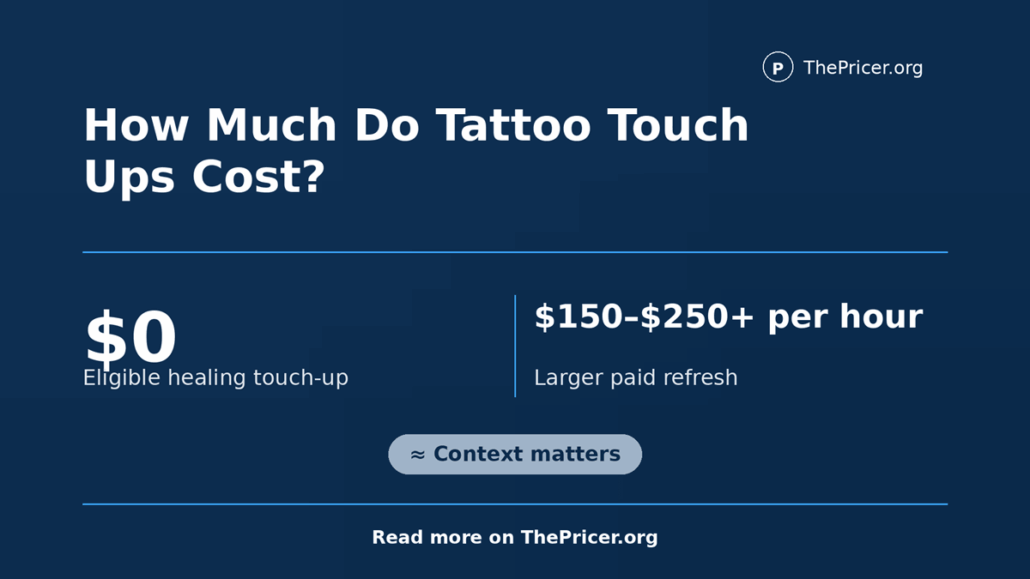
A tattoo touch-up can cost $0 when your original artist includes a complimentary healing correction. Once the free window expires, small paid touch-ups often start around $50 to $100+, while larger refreshes can be charged at the artist’s normal rate, with current studio examples around $150 to $250+ per hour.
The price depends heavily on why you are going back. Fixing a small patch that healed lighter than expected is very different from refreshing a tattoo that has faded for years, changing colors, adding new elements, or reworking someone else’s tattoo. Many studios treat the first situation as part of the original service and charge $0. The others may be priced like new tattoo work.
Current studio policies show just how wide the spread can be. Great Lakes Tattoo offers complimentary touch-ups for up to one year on tattoos it originally applied, while Leah Earl Tattoo says minor touch-ups requested after the first year are usually around $100. Zigzag Tattoo offers a first touch-up free within one year, charges $75 for a second touch-up during that year, and lists later touch-ups at $150 per hour.
Article Highlights
Jump to sections
- One healing touch-up can cost $0 when it is included by the original artist.
- Minor paid touch-ups can start around $50 to $100+ (at $30 per hour, earning that amount would take about 1.7 to 3.3 hours of work, before taxes) based on current artist policies.
- Later or larger refreshes may be charged at standard tattoo rates of roughly $150 to $250+ per hour in current studio examples.
- Great Lakes Tattoo has a $100 shop minimum and charges $250 per hour for larger tattoo work.
- Zigzag Tattoo charges $75 for a second touch-up within the first year and $150 per hour for later touch-ups.
- A refundable $50 touch-up deposit is not the same thing as a $50 touch-up fee.
- Hands, feet, fingers, elbows, neck areas, poor aftercare, design changes, and missed deadlines can make an otherwise free touch-up chargeable.
How Much Do Tattoo Touch Ups Cost?
| Studio or artist | Current touch-up policy | Published price signal |
|---|---|---|
| Great Lakes Tattoo | Complimentary for up to 1 year on its own tattoos | $0 eligible touch-up, $100 (about 3.3 hours of work at $30 per hour) shop minimum, $250/hour for larger tattoo work |
| Certified Tattoo Studios | One free touch-up within 1 year, no sooner than 90 days | $0 if eligible, excluded placements charged at full price |
| Leah Earl Tattoo | Free within 1 year | Minor later touch-ups usually around $100 |
| Zigzag Tattoo | First touch-up free within 1 year | Second touch-up $75, later touch-ups $150/hour |
| Kail Tattoos | One complimentary touch-up within 1 year | $50 refundable booking deposit, additional work can have a $150 minimum |
| The Body Shop Tattoos | One complimentary touch-up within 6 to 8 weeks | Later or ineligible work charged at normal hourly rate or shop minimum |
Great Lakes Tattoo publishes one of the clearest current examples. Its touch-up and tattoo pricing policy gives clients complimentary touch-ups for up to one year on tattoos done there. For other work, the price depends on how much tattooing is required. The shop minimum is $100, while larger tattoos that need multiple sessions are priced at $250 per hour.
Leah Earl Tattoo has a similarly useful one-year touch-up policy. Eligible touch-ups during that window are free. After one year, minor work is usually around $100, while larger corrections, color adjustments, or additions can move to the artist’s minimum or hourly rate.
When a Touch-Up Costs $0
A free touch-up is not unusual. Certified Tattoo Studios currently includes one complimentary touch-up within one year of completing the tattoo, although clients must wait at least 90 days for healing. Great Lakes and Leah Earl also use one-year windows, while other artists use shorter periods.
Aurora Tattoo Co., for example, states that complimentary touch-ups last 6 months to 1 year depending on the artist. The Body Shop Tattoos uses a much narrower 6-to-8-week complimentary window. There is no universal industry deadline.
The free service is normally aimed at small healing issues, such as a patch that lost pigment or a line that needs a minor pass after the skin settles. It does not give the customer an unlimited right to redesign the tattoo months later. If you change the color, add lettering, extend the design, or ask for substantial new shading, the artist can treat the appointment as new work.
When Free Stops Being Free
The hidden price is often in the exclusions. Certified Tattoo Studios excludes several high-fade or difficult placements from its complimentary policy, including areas below the wrist, below the ankle, elbows, and areas above the collar. Aurora also excludes hands, feet, inner lips, and other placements prone to pigment loss.
Aftercare can matter too. The Body Shop says its complimentary service is void when pigment loss comes from poor aftercare such as picking or scratching, premature sun exposure, or submerging the tattoo too early. Leah Earl has similar exclusions for negligent aftercare and high-fade placements such as fingers, palms, and the side of the foot.
Missed appointments can create a real charge as well. Zigzag Tattoo’s current touch-up policy gives the first eligible touch-up free within one year and a second for $75 (about 2.5 hours of work at $30 per hour). A no-show can forfeit the free touch-up, after which the artist lists a $150 per hour rate with a $150 minimum.
Deposits Are Not Touch-Up Fees
Some online booking pages make a free touch-up look paid because they require money to reserve the appointment. Kail Tattoos is a good example. Its touch-up booking page shows $50, but that amount is a refundable deposit rather than the service price. The artist says it is returned when the client attends as scheduled.
Kail includes one complimentary touch-up within one year. A no-show or same-day cancellation can forfeit the free session and lead to a $50 fee for future touch-ups. Additional work can also be subject to a $150 minimum.
That distinction matters when comparing quotes. A $50 refundable deposit creates a temporary cash outlay of $50, but the net service cost remains $0 when the deposit is returned and the touch-up qualifies as complimentary. Ask whether any booking payment is refundable, credited toward the bill, or retained as a separate charge.
Original Artist vs a Different Artist
The original artist is usually the first person to contact for a fresh tattoo that healed unevenly. Complimentary policies commonly apply only to the artist’s own work. An artist who did not create the tattoo has no original-session payment from which to absorb the correction, so the appointment is more likely to start at the shop minimum or normal hourly rate.
This difference can turn the same small correction from $0 into $100+. At Great Lakes, for example, eligible work originally done at the shop can be complimentary for a year, while tattoos done elsewhere are assessed according to how much work is required. Its normal minimum is $100.
For old or poorly executed work, choose an artist based on whether the portfolio shows experience with that style and with reworking existing tattoos. Price alone is not enough. A new artist may need to redraw sections, change contrast, add background work, or make the design larger to produce a clean result.
Touch-Up, Refresh, Rework
A touch-up normally restores what was already supposed to be there. A refresh can bring color or contrast back to an older tattoo. A rework changes or develops the existing design. A cover-up uses a new design to hide part or all of the old tattoo. Those categories overlap in everyday language, but they do not have the same price.
Three Kings Tattoo explains that tattoo quotes depend on size, detail, placement, color, drawing, and research. Once a supposed touch-up involves meaningful redesign work, those normal tattoo-pricing variables become much more important than the age of the tattoo.
A tattoo blowout is another reason not to assume a quick free correction will solve every problem. A blowout means pigment has spread beneath the intended area. Certified Tattoo Studios notes that minor blowouts may be masked with added detail or shading, while larger cases may call for a cover-up or laser treatment. Adding ink can disguise a blowout, but it does not remove the pigment that has already spread.
What a Paid Refresh Can Cost
For a small touch-up after the free period, a realistic starting budget is around $100 based on current published artist examples. If the job becomes an extended refresh, the standard hourly rate can matter more. Zigzag lists later touch-ups at $150 per hour, while Great Lakes lists $250 per hour for larger tattoo work.
Worked example: at a $150-per-hour touch-up rate, 90 minutes of tattooing costs about $225. At a $250-per-hour standard rate, the same 90 minutes would calculate to $375. These are arithmetic examples, not universal quotes, because each artist decides whether a particular refresh qualifies for hourly pricing.
Case 1, recent healing correction: you return to an artist whose policy includes one eligible healing touch-up. The service cost can be $0.
Case 2, minor refresh after the deadline: Leah Earl says minor touch-ups after one year are usually around $100. That is a useful benchmark for a small paid correction.
Case 3, larger old-tattoo refresh: if an artist expects 90 minutes and quotes $150 per hour, budget about $225. If the artist instead treats the work as a complex rework, the quote can rise because drawing, new design elements, and additional sessions may be involved.
When to Schedule the Touch-Up
Do not schedule a cosmetic correction while the tattoo is still actively healing unless your artist specifically asks to see it. Policies vary. Certified Tattoo Studios requires at least 90 days before its free touch-up, while The Body Shop asks eligible clients to complete the complimentary session within 6 to 8 weeks. Follow the timeline given by the artist who did your tattoo.
There is also no standard rule that every tattoo needs a paid refresh every 2 to 5 years. Some tattoos may need a small healing correction and then remain satisfactory for years. Others fade faster because of placement, sun exposure, skin characteristics, friction, style, pigment, or how the tattoo was applied.
Ask for an assessment when you notice specific problems rather than paying for maintenance simply because a calendar interval has passed. A photo can often help the artist decide whether the tattoo needs a short touch-up, a larger refresh, or no work at all.
Aftercare

Fresh tattoo work needs time to heal again after a touch-up. Cleveland Clinic’s 2026 dermatologist-reviewed tattoo aftercare guidance recommends gentle washing, a simple moisturizer, avoiding picking or scratching, and staying out of pools, hot tubs, and baths while the skin heals. Follow the artist’s bandage instructions because products and healing protocols differ.
Sun protection matters after healing. The American Academy of Dermatology recommends broad-spectrum, water-resistant SPF 30 or higher on tattooed skin when exposed to sunlight. UV light can fade tattoo pigment, so sun protection can reduce one source of premature fading.
If the area develops worsening pain, expanding redness, significant drainage, fever, or other signs that concern you, contact a medical professional rather than treating the problem as a normal touch-up issue.
Related Body Art Costs
If the tattoo needs more than a minor refresh, compare the price with the cost of getting a new tattoo. If you are comparing other body-art expenses, see our guide to nose piercing costs. A large rework can approach new-tattoo pricing because the artist may be doing substantial design and tattooing rather than simply filling a small healed gap.
Answers to Common Questions
Do tattoo artists do touch-ups for free?
Many do. Current studio policies show one complimentary healing touch-up lasting anywhere from about 6 to 8 weeks to one year. Eligibility can depend on placement, aftercare, timing, and whether the artist did the original tattoo.
How much is a small paid tattoo touch-up?
A useful planning figure is about $50 to $100+, with a current artist example putting minor later touch-ups around $100. Shop minimums can make even a quick correction cost more.
How much does a larger tattoo refresh cost?
Larger work can be charged at standard tattoo rates. Current published examples relevant to this market range from about $150 to $250+ per hour, although the artist may quote a flat amount instead.
Does a free touch-up include changing my tattoo?
Usually not. Complimentary touch-ups are meant to correct healing-related pigment loss or small imperfections. Adding new colors, changing the design, extending the tattoo, or substantial reworking can be billed as new tattoo work.
How often should a tattoo be touched up?
There is no fixed interval. Have the tattoo assessed when you see fading, patchy pigment, lost detail, or another problem that actually needs work. Some tattoos may go many years without a paid refresh.
Disclosure: Educational content, not financial advice. Prices reflect public information as of the dates cited and can change. Confirm current rates, fees, taxes, and terms with official sources before purchasing. See our methodology and corrections policy.