
How Much Does a Cockatoo Cost?
Updated on | Written by Alec Pow
This article was researched using 14 sources. See our methodology and corrections policy.
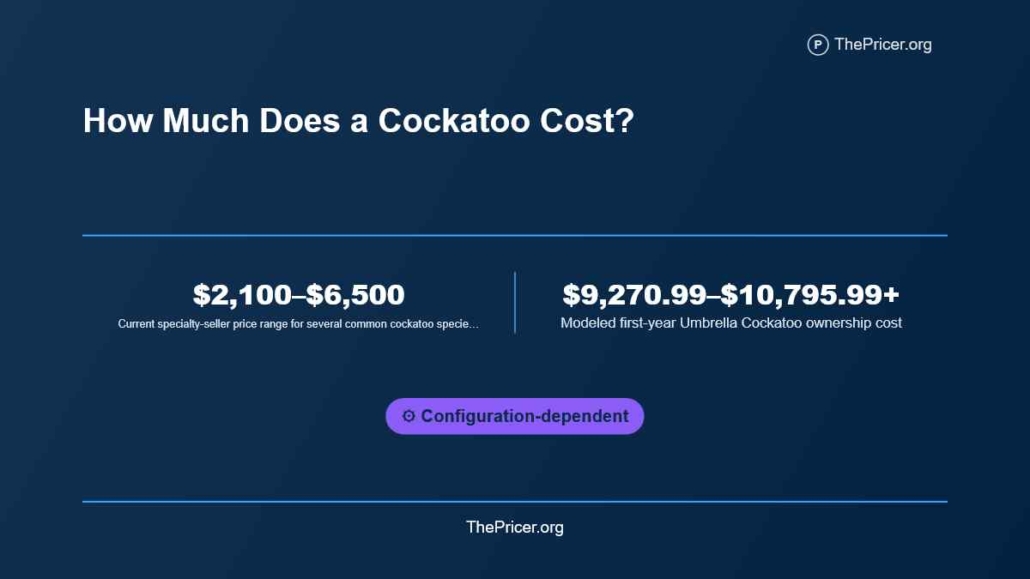
A cockatoo can cost about $2,100 to $6,500 from current U.S. specialty sellers for several commonly kept species, while rare Palm Cockatoos can reach roughly $15,000 to $25,000+. Adoption can be much cheaper, with a current rescue schedule listing cockatoos at about $500 to $650. The bird price is only one part of ownership. A large cage, food, chew toys, veterinary care, cleaning supplies, insurance, and decades of replacement costs can push the first-year bill well beyond the purchase price.
Cockatoo prices vary sharply by species, age, tameness, seller, health records, and whether the bird is a companion, breeder, rescue, or rare protected species. A Goffin’s and a Palm Cockatoo should not be treated as the same market.
Article Highlights
Jump to sections
- Current specialty-seller prices for several common cockatoos run from about $2,100 to $6,500 (at $30 per hour, earning that amount would take about 1.8 to 5.4 full-time workweeks, before taxes).
- A current rescue schedule puts cockatoo adoption fees around $500 to $650.
- A large powder-coated cage sold for large cockatoos is currently listed at $1,315.99.
- Large-parrot food and enrichment can add roughly $1,560 to $3,000+ per year using published rescue-budget ranges.
- A modeled first year with a $5,800 Umbrella Cockatoo reaches about $9,271 to $10,796 before tax, shipping, insurance, and emergency treatment.
How Much Does a Cockatoo Cost?
The strongest current retail snapshot comes from one U.S. specialty seller that lists multiple cockatoo species on the same pricing page. Its current cockatoo listings show Goffin’s Cockatoos at $2,100 to $2,200 (about 1.8 full-time workweeks at $30 per hour), Umbrella Cockatoos at $2,500 to $5,800, Sulphur-crested Cockatoos at $4,000 to $4,500, a Moluccan Cockatoo at $5,000, and a Rose-breasted Cockatoo at $6,500. Some entries are sold out, so these are observed asking prices rather than a promise of current availability.
Palm Cockatoos sit outside that common-species band. A 2026 cockatoo buyer price guide places Palm Cockatoos around $15,000 to $25,000+. That range deserves a separate label because public availability is thin and the species is heavily regulated in international trade. Public availability also changes from week to week, so an asking price should be treated as a dated market signal rather than a completed-sale average.
| Cockatoo price example | Current or recent asking price | What changes the number |
|---|---|---|
| Goffin’s Cockatoo | $2,100 to $2,200 | Seller, age, handling, testing |
| Umbrella Cockatoo | $2,500 to $5,800 | Baby versus adult, tameness, seller |
| Moluccan Cockatoo | $5,000 | Availability, age, socialization |
| Rose-breasted Cockatoo | $6,500 | Availability and seller |
| Palm Cockatoo | $15,000 to $25,000+ | Rarity, documentation, availability |
Why Species Changes the Price
Cockatoo is a family label, not one uniform pet product. Goffin’s, Umbrella, Galah, Moluccan, Sulphur-crested, Major Mitchell’s, and Palm Cockatoos differ in body size, rarity, breeding difficulty, legal status, availability, and demand. Those differences affect both the purchase price and the equipment needed after the bird comes home. A smaller Goffin’s may fit a different housing plan from a large Moluccan, while a Palm Cockatoo carries a scarcity premium that can exceed the entire first-year budget for a more common bird.
Age and history matter as well. A hand-raised, fully weaned young bird with DNA sexing and health documentation can command more than an older rehome, an untamed breeder, or a bird with behavioral or medical concerns. The lowest classified price can also hide future spending if the cage is undersized, the bird needs veterinary work, or the buyer must replace damaged equipment. That is why a price comparison should match species, age, tameness, health information, included cage or accessories, and transport terms before deciding which bird is cheaper.
The same rule applies across other companion birds. A cockatiel purchase sits far below a large cockatoo in acquisition and housing cost, while an Indian Ringneck parrot occupies a different middle tier. Comparing only the animal price misses the bigger ownership package.
Adoption Can Cut the Cost
Rescue adoption can reduce the acquisition price by thousands of dollars. Florida Parrot Rescue currently lists small cockatoos such as Goffin’s at $500 (about 2.1 full-time workdays at $30 per hour) and large cockatoos such as Moluccans, Umbrellas, Sulphur-crested, Citron, and Triton Cockatoos at $650. Its cockatoo adoption schedule states that a cage is included when the bird has one.
Those fees show why adoption and breeder purchase should not be blended into one average. A large-cockatoo rescue fee of $650 is $5,150 below the $5,800 Umbrella baby price used later in the worked example. That difference can pay for a large cage and a substantial share of the first year’s food and enrichment. The lower fee does not make an adopted bird cheap to own. Veterinary needs, behavior work, damaged cages, replacement perches, and household changes may still add large bills.
Adoption also changes what the buyer is selecting. A rescue may know the bird’s behavior, diet, prior veterinary history, and compatibility issues, while a breeder sale may offer a younger bird with a different socialization history. The financially useful comparison is total first-year setup and care, not rescue fee against breeder price alone.
Cage and Setup Costs
 Large cockatoos need sturdy housing built around their body size, wingspan, activity, and strong beaks. A current A&E Cage Company model measuring 48 by 36 by 76 inches is listed at $1,315.99 and marketed for large cockatoos and large macaws. The large cockatoo cage listing includes stainless feeder cups and perches, but a household will still need species-appropriate perches, chew items, a travel carrier, cleaning tools, and safe play areas outside the cage.
For the first-year model, ThePricer uses a $300 setup allowance for a carrier, extra perches, bowls, and initial accessories beyond what comes with the cage. That number is an explicit planning assumption, not a national market average. Buyers who choose stainless steel housing, a separate sleep cage, a large play stand, custom indoor aviary work, or multiple rooms of bird-safe equipment can spend much more.
Cockatoos are powerful chewers. A cage that looks large enough on a product page can still be a poor match if bar spacing, wire strength, door locks, or interior layout are wrong for that bird. The housing decision should be made for the exact species and individual, not from the cheapest item carrying the word “parrot.”
Food and Enrichment Costs
Food should be budgeted as a recurring care category rather than a bag of seed. VCA’s current cockatoo feeding guidance recommends a formulated pellet diet at roughly 75% to 80% of intake, with limited fruits and vegetables and only a small role for seeds. That directly contradicts the old idea that a seed-heavy diet is an adequate low-cost feeding plan.
Heartland Avian Rescue Project gives a useful ownership-budget framework for larger parrots. Its parrot ownership cost guide puts food for an extra-large parrot at $50 to $100+ per month and toys and perches at $80 to $150+ per month. Annualized, those two categories alone equal about $1,560 to $3,000+. Cockatoos can destroy wood, paper, rope, and foraging items quickly, so enrichment is a recurring replacement cost rather than a one-time setup purchase.
Food quality also affects the comparison between sellers. A bird already eating a balanced pellet-led diet may be easier to budget for than one that needs a slow veterinary-guided diet change. Fresh produce, treats, food waste, and regional grocery prices can move the real total above the published planning range. Owners comparing a cockatoo with a smaller talking parrot should expect size and destructive behavior to widen the recurring-cost gap.
Avian Vet and Insurance
Routine veterinary care belongs in the annual budget. A 2026 avian pricing review reports bird wellness exams around $115 to $200, while new-patient visits can reach $135 to $225 before diagnostics. The current avian vet ranges also show how bloodwork, imaging, urgent care, and surgery can move the bill well beyond the examination fee. A low bird purchase price does not protect an owner from a four-figure medical episode.
Routine beak trimming should not be treated as a fixed annual cockatoo expense. VCA states that a healthy bird should rarely need the upper or lower beak trimmed, and an overgrown beak can point to an underlying medical issue. Its bird beak care guidance also warns against home beak trimming. Nail care is different and may be needed based on wear, perch setup, and the individual bird.
Bird insurance exists, but a universal cockatoo premium cannot be supported from a public price table. Nationwide states that it offers pet health insurance for birds and exotic pets and notes that eligibility and availability can vary. Its bird insurance information requires a quote for the actual policy. The first-year model below leaves insurance out rather than inventing a monthly premium.
First-Year and Lifetime Cost
A practical first-year total can be built from current price signals plus stated household allowances. Take the $5,800 Umbrella Cockatoo asking price, the $1,315.99 large cage, annual food of $600 to $1,200+, annual toys and perches of $960 to $1,800+, and a wellness exam of $115 to $200. Add a chosen $300 starter-accessory allowance and $180 for cleaning supplies. The modeled first year reaches about $9,270.99 to $10,795.99+ before tax, shipping, insurance, emergency care, behavior consultations, and replacement cages.
Swap the breeder bird for the $650 large-cockatoo rescue fee while keeping the same housing and care assumptions, and the modeled first year falls to about $4,120.99 to $5,645.99+. The acquisition choice changes the model by $5,150, yet the remaining care bill still exceeds $3,470 before excluded expenses. This is why adoption lowers the entry cost without turning a cockatoo into a low-cost pet.
The long horizon is larger. LafeberVet lists a general cockatoo mean lifespan of 30 to 45 years and notes that Moluccans can live up to 70 years on its cockatoo clinical reference. Using only annual food, toys, one wellness exam, and the $180 cleaning allowance gives a recurring baseline of about $1,855 to $3,380+ per year. Held flat for 30 years, that becomes roughly $55,650 to $101,400+ before inflation, major medical care, insurance, new cages, boarding, or the original bird price.
Legal Rules and Ownership Fit
Most U.S. buyers will not pay a routine federal “cockatoo permit fee” simply for owning a domestically acquired companion bird, so the old $25 to $250 generic permit claim should be removed. International movement is different. The U.S. Fish and Wildlife Service explains that the Wild Bird Conservation Act limits or prohibits imports of exotic birds when trade is not beneficial to the species. Import, export, and re-export can require federal wildlife documentation depending on species, origin, and purpose. State and local animal rules can add another layer.
A cheap online listing is not a substitute for legal provenance, health records, and the paperwork required for the specific transaction. Buyers should also confirm housing rules, landlord terms, noise restrictions, and veterinary access before paying a deposit. Cockatoos can be extremely loud and can damage woodwork, furniture, doors, and household fixtures.
Makes sense if
- You can fund a large cage and recurring enrichment without relying on the bird staying undemanding.
- You already have access to an avian veterinarian and can absorb emergency costs.
- You can commit to decades of daily interaction, cleaning, and noise management.
- You have checked the legal and housing rules that apply to your location and species.
Does not make sense if
- Your budget stops at the purchase price.
- You need a low-noise pet or cannot tolerate destructive chewing.
- You expect routine beak trimming or a seed-heavy diet to substitute for proper care.
- You cannot make a long-term plan for a bird that may outlive major changes in your household.
Answers to Common Questions
How much does a cockatoo cost in 2026?
Current specialty-seller examples for several commonly kept species run about $2,100 to $6,500. Rare Palm Cockatoos can reach roughly $15,000 to $25,000+, while rescue adoption can be around $500 to $650.
How much should I budget for the first year?
The worked Umbrella Cockatoo scenario above reaches about $9,270.99 to $10,795.99+ before tax, shipping, insurance, emergency treatment, and behavior services. An adoption-based version of the same setup falls to about $4,120.99 to $5,645.99+.
Do cockatoos need routine beak trimming?
No. A healthy bird should rarely need routine beak trimming. Beak overgrowth or abnormal shape should be evaluated by an avian veterinarian because it may be linked to a medical problem.
How long do cockatoos live?
A general clinical reference gives a mean lifespan of about 30 to 45 years for cockatoos, with Moluccans capable of living much longer. Individual lifespan varies with species, health, history, and care.
Disclosure: Educational content, not medical advice. Pricing varies by provider, location, and insurance. Confirm eligibility, coverage, and out-of-pocket costs with a licensed clinician and your insurer. See our methodology and corrections policy.