
How Much Does a Monkey Cost?
Updated on | Written by Alec Pow
This article was researched using 14 sources. See our methodology and corrections policy.
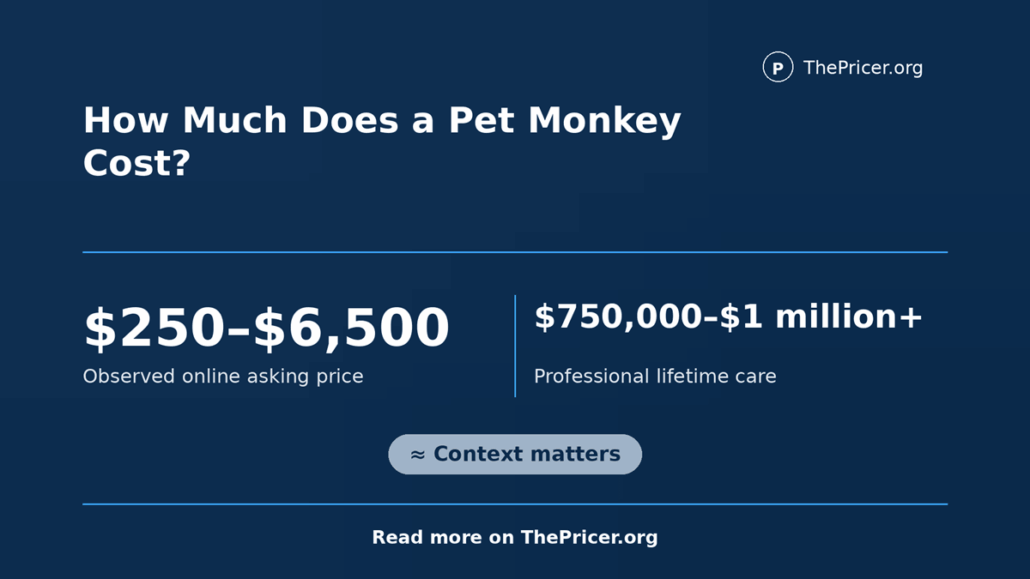
Current U.S.-targeted online listings for live primates have shown asking prices from $250 to $6,500, but there is no dependable national “pet monkey price.” A 2026 U.S. primate trade study found that range across social-media offers involving macaques, capuchins, marmosets, spider monkeys and other primates. Those were advertised prices, not verified lawful sales.
The practical legal purchase price can be $0 where private possession is prohibited or permit conditions cannot be met. Current federal animal import guidance also says nonhuman primates may not be imported as pets under any circumstances. Even where domestic possession can be lawful, the animal’s asking price can be tiny beside long-term housing, food, veterinary care, enrichment and regulatory costs.
“Pet monkey” is a broad label covering animals with very different body sizes, lifespans, social structures, diets, enclosure needs and legal status. A marmoset, capuchin, macaque, spider monkey and chimpanzee should not be treated as interchangeable versions of the same purchase.
Article Highlights
Jump to sections
- Online market: current asking prices run from hundreds to several thousand dollars, but the listings are not verified lawful sales.
- Species gap: macaques, capuchins, marmosets and spider monkeys show different advertised price patterns.
- Import rule: there is no lawful U.S. pet-import route for a nonhuman primate.
- State rules: possession can be prohibited, permit-based or subject to experience and enclosure requirements.
- Lifetime care: professional primate-care estimates can outweigh the animal’s asking price by orders of magnitude.
- Online listing warning: an “adoption,” “rehoming” or delivery fee does not prove that the transaction or the animal’s origin is lawful.
How Much Does a Pet Monkey Cost?
The strongest recent market snapshot is the 2026 Primates for Purchase report. Researchers found 1,131 social-media posts offering at least 1,614 live primates between June 15 and August 1, 2025. Macaque asking prices ran from $250 to $6,500 (at $30 per hour, earning that amount would take about 0.2 to 5.4 full-time workweeks, before taxes) and averaged $1,005. Capuchins ran from $300 to $6,500 and averaged $859. Marmosets ran from $250 to $6,500 and averaged $1,174. Spider monkeys ran from $300 to $6,500 and averaged $757, while squirrel-monkey listings averaged $706.
Those figures are useful as a market signal, not as a shopping guide. The report found that sellers sometimes used words such as adoption and rehoming while still requesting payment. It also found that many listings did not establish the animal’s lawful origin or whether possession was legal where the buyer lived.
| Cost signal | Current figure | What the number really means |
|---|---|---|
| Observed online primate asking price | $250-$6,500 | Advertised price in a 2026 U.S. trade study, not a verified legal sale price |
| Florida Class III personal pet permit | $0 | Permit fee only. Species-specific experience and caging rules can still apply |
| California private pet route | $0 lawful purchase route | CDFW says monkeys are not allowed as pets and restricted-species permits are not issued for pet purposes |
| Florida capuchin experience requirement | 1,000 hours | Documented experience barrier before a personal-possession permit can be issued |
| Professional lifetime care example | $750,000 to $1 million+ | Published professional-care estimates for a black-capped capuchin and infant spider monkey, not household pet budgets |
What You’re Buying
A nonhuman primate is a wild animal, not a domesticated pet breed. Species differ sharply in adult strength, group behavior, activity patterns, diet and housing. Many need extensive climbing space, species-appropriate social contact and daily enrichment. An infant that appears manageable can mature into an animal with very different behavior and physical ability.
The transaction itself also differs from buying a dog or cat. A buyer may face wildlife rules, permit eligibility, enclosure standards, inspections and limits on transport. Federal dealer licensing can apply to sellers without granting the buyer permission to keep the animal. A domestic sale that appears online can still conflict with state or municipal rules. Price is only one part of the legal and care equation.
The Legal Price Can Be $0
Federal law and state wildlife law answer different questions. The CDC states that pet primate importation is illegal. Nonhuman primates may be imported only for permitted scientific, educational or exhibition uses, not to become household pets.
Domestic possession varies by location. Florida, for one example, has a Class III personal wildlife permit that currently costs $0 and covers listed species including marmosets, tamarins, capuchins and spider monkeys. That free permit does not mean anyone can simply purchase one. Separate experience, facility and species rules may apply.
California mini case: California takes a different route. CDFW’s current exotic-pet guidance names monkeys among animals that are not allowed as pets and says restricted-species permits are issued only for limited purposes such as research, public exhibition, education or shelter, not pet ownership. For an ordinary private buyer in California, the practical lawful pet purchase price is $0.
This is why state, county and city rules need to be checked before treating any online asking price as usable. If the location prohibits private possession or the applicant cannot meet permit conditions, the lawful pet-market price there is effectively $0.
A Cheap Listing Is Not the Real Total
A low online price can exclude almost everything that determines whether the animal can be housed lawfully and humanely. The buyer still has to resolve enclosure construction, heating or cooling, diet, enrichment, veterinary access, transport, waste management and any permit or inspection requirements.
Seller status is another separate issue. USDA APHIS says animal dealers and exhibitors must hold the applicable federal license, and its Animal Care search tool lets the public check licensees and inspection records. A USDA license does not override state or local possession law.
Florida capuchin mini case: the 2026 trade report found a capuchin average asking price of $859 (about 3.6 full-time workdays at $30 per hour). Florida’s current capuchin permit rules require applicants seeking personal possession of capuchin, spider or woolly monkeys to document 1,000 hours of qualifying experience over at least one calendar year, provide two references and pass a caging inspection. The permit fee may be $0, but the entry barrier is plainly not zero.
Worked minimum example: take the observed $1,174 average marmoset asking price from the online-trade study and pair it with Florida’s $0 personal Class III permit fee. The documented subtotal is still $1,174. A compliant enclosure, veterinary care, food, enrichment and transport remain outside that number, so calling $1,174 an “all-in marmoset cost” would be misleading.
Decades of Care

The purchase price can be the smallest number in the ownership story. The 2026 primate-trade report cites professional lifetime-care estimates of more than $1 million (about 16 years of full-time work at $30 per hour) for one infant spider monkey over 30 years and up to $750,000 for an infant black-capped capuchin. Those are professional-care estimates, not forecasts for a private home, but they show the scale of long-term primate husbandry.
Sanctuary operating costs show where the money goes. Born Free USA reports spending just over $141,000 per year on food for the monkeys in its care, along with heating, shelters, enrichment, maintenance and veterinary expenses. Bulk sanctuary spending cannot be converted directly into one pet monkey’s grocery bill, but it exposes why an old $25-per-week food estimate is not enough to describe the financial commitment.
The care-to-price ratio can be extreme. Comparing the observed spider-monkey average asking price of $757 with the cited professional lifetime-care estimate above $1 million means the care estimate is more than 1,300 times the advertised animal price. Spread across the cited 30-year care horizon, $1 million also averages more than $33,333 per year. These are professional-care comparisons, not household forecasts, but they show why the sticker price should never lead the ownership decision.
Chimpanzees and Service Monkeys
Chimpanzee mini case: a chimpanzee should not appear in a normal pet-price table. The U.S. Fish and Wildlife Service classifies all wild and captive chimpanzees as endangered. Its chimpanzee endangered-species rule restricts activities including interstate and foreign commerce without the required federal authorization. A historical or online asking price does not create a normal lawful pet market.
The old idea that a person with a disability can currently obtain a trained capuchin at no charge also needs correction. Helping Hands: Monkey Helpers once placed trained capuchins with people who had mobility impairments, but the organization says it wound down that model and moved toward assistive technology. Its current program history says monkey training and placement was winding down in 2020 and the organization later became Envisioning Access.
When This Cost Makes Sense
Makes sense if:
- The exact species is lawful to possess at your address and every required permit can be obtained.
- You already have access to a veterinarian willing and qualified to treat the species.
- You can fund species-appropriate housing, enrichment and care for decades rather than only the purchase price.
- You have verified the seller’s legal status and the animal’s documentation without relying on a social-media claim.
Does not make sense if:
- The plan starts with finding the cheapest baby monkey online.
- You are relying on an imported animal or a seller promising to bypass federal import rules.
- Your budget covers the animal but not enclosure construction, veterinary care and long-term husbandry.
- You expect an infant primate to remain easy to handle as an adult.
- Local law, landlord rules or insurance restrictions have not been checked.
What We Verified
- Checked: the current federal primate import regulation says imported nonhuman primates, including their offspring, may not be maintained, sold or distributed for use as pets or hobbies.
- Confirmed: Florida’s current primate enclosure rules set species-specific minimum dimensions and require features such as perching, shelter, climbing equipment and enrichment.
- Cross-referenced: CDC’s current B virus guidance identifies macaques as the source of B virus infection in people and says bites, scratches and contact with infected tissue or fluid can transmit it.
Related Exotic Animal Costs
The price of a marmoset monkey and the separate market for a so-called finger monkey should be read with the same legal and provenance caveats used here. A low advertisement is not proof that the animal can legally be kept at the buyer’s address.
The cost of a capuchin monkey also needs to be compared with permit eligibility, enclosure rules and lifetime care rather than with the purchase price of a domesticated pet.
Answers to Common Questions
How much does a monkey cost in the United States?
A 2026 U.S. online-trade study observed asking prices from $250 to $6,500. Those were advertisements, not verified lawful pet transactions, and the legal answer depends on species and location.
Can I import a monkey into the U.S. as a pet?
No. Federal public-health rules do not allow nonhuman primates to be imported for use as pets.
How much does a capuchin monkey cost?
The 2026 online-trade study found capuchin asking prices from $300 to $6,500, averaging $859. Treat those as observed advertisements rather than a normal legal retail price.
How much does a chimpanzee cost as a pet?
There is no useful normal U.S. pet-market price. All chimpanzees are federally listed as endangered, and commercial activity involving them is heavily restricted.
Is the cage the biggest extra expense?
Not necessarily. Housing is only one line item. Long-term food, enrichment, specialized veterinary care, maintenance, heating or cooling, permits and decades of care can dwarf the initial asking price.
Disclosure: Educational content, not medical advice. Pricing varies by provider, location, and insurance. Confirm eligibility, coverage, and out-of-pocket costs with a licensed clinician and your insurer. See our methodology and corrections policy.