
How Much Does a Used School Bus Cost?
Updated on | Written by Alec Pow
This article was researched using 10 sources. See our methodology and corrections policy.
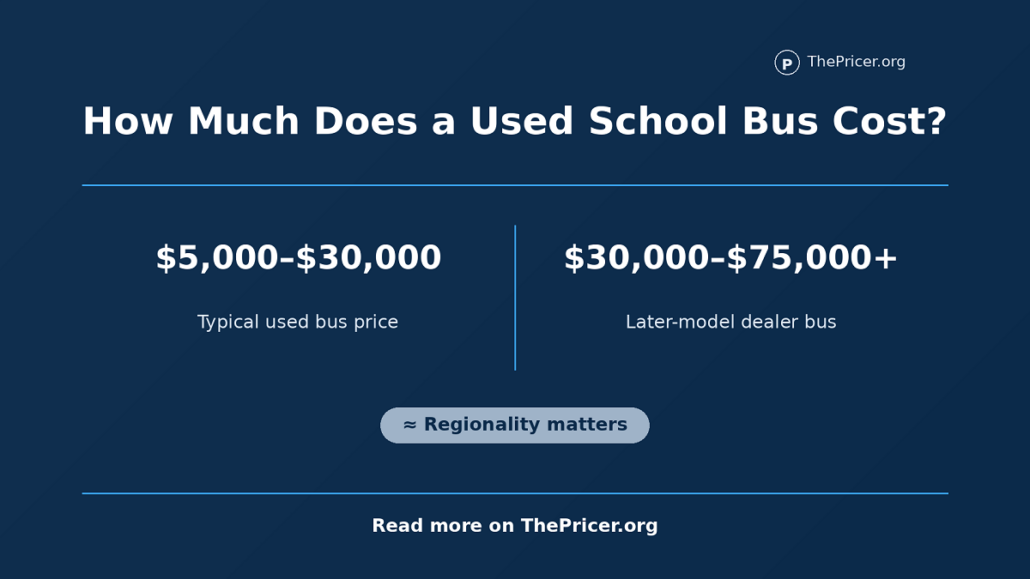
A used school bus commonly costs $5,000 to $30,000, while later-model, low-mileage, dealer-inspected, or wheelchair-equipped buses can cost $30,000 to $75,000 or more. Government auction buses may attract bids below $5,000, but transportation, auction fees, tires, batteries, mechanical repairs, title work, and registration can push the road-ready total above $10,000 to $20,000.
The sale price alone does not tell a buyer whether the bus is usable. A $6,000 auction bus with dry-rotted tires, rust, warning lights, and no legal way to drive it home can cost more than a $20,000 dealer bus that has been inspected and prepared for the road. Engine model, transmission, mileage, engine hours, corrosion, title status, and intended use all change the real cost.
A used school bus may be purchased for private transportation, a mobile business, farm use, equipment hauling, an activity bus, or conversion into a motorhome commonly called a skoolie. Each use creates different insurance, licensing, seating, registration, and equipment requirements.
Article Highlights
Jump to sections
- Many used school buses cost $5,000 to $30,000 (at $30 per hour, earning that amount would take about 1 to 5.8 months of full-time work, before taxes).
- Serviceable Type C buses commonly cost $12,000 to $30,000.
- Later-model dealer buses may cost $30,000 to $75,000+.
- An auction bid below $5,000 can become a $12,000+ road-ready purchase.
- A DIY skoolie build can add $15,000 to $50,000+ before major professional labor.
- Commercial insurance, passenger use, and CDL rules can change the ownership cost.
- Rust and neglected mechanical systems matter more than paint, seats, or mileage alone.
Current Used School Bus Prices
Dealer guidance places high-mileage or export-condition school buses near $3,000 (about 2.5 full-time workweeks at $30 per hour), while late-model Type D buses can reach $50,000 or more. A serviceable Type C conventional bus commonly falls between $12,000 and $30,000, according to current used school bus inventory guidance.
A more recent 2026 dealer analysis places fair-to-good Type C diesel buses at $12,000 to $45,000. Buses under five years old with lower mileage may reach $40,000 to $80,000, while a 10- to 12-year-old bus with 100,000 to 150,000 miles may cost $15,000 to $30,000. Those figures appear in the dealer’s 2026 school bus price guide.
| Used school bus category | Planning price | Likely buyer |
|---|---|---|
| Non-running or high-risk auction bus | $1,000 to $6,000 | Parts buyer, mechanic, exporter, or project buyer |
| Older running auction bus | $4,000 to $12,000 | Budget buyer willing to fund repairs |
| Type A short school bus | $8,000 to $25,000 | Small conversion, shuttle, or local-use buyer |
| Serviceable Type C conventional bus | $12,000 to $30,000 | Skoolie builder, organization, contractor, or fleet buyer |
| Full-size Type D transit-style bus | $15,000 to $50,000+ | Large conversion, export, or passenger operation |
| Later-model dealer-inspected bus | $30,000 to $75,000+ | Buyer seeking lower mileage and fewer immediate repairs |
| Completed skoolie conversion | $30,000 to $150,000+ | Buyer seeking a finished motorhome |
New school buses cost far more than the old $50,000 to $55,000 estimate. A 2026 Arkansas state contract lists an 84-passenger Blue Bird rear-engine bus at $189,050. The published state school bus contract shows why the savings from buying used can exceed $100,000 rather than only $30,000 to $40,000.
What the Purchase Price Includes
A dealer price may include cleaning, fluid checks, title processing, basic mechanical inspection, replacement batteries, or delivery. It may also include none of those services. An auction bus is more likely to be sold as-is, where-is, with no warranty and a short removal deadline.
The buyer should ask whether the advertised price includes:
- A clear title or transferable ownership document
- Current state inspection where required
- Roadworthy tires with documented manufacture dates
- Charged batteries and a functioning alternator
- Air-brake, steering, and suspension inspection
- Working exterior lights and instruments
- Diagnostic scans for engine and transmission faults
- Delivery or pickup assistance
- Removal of school identification equipment where required
Do not compare a $6,000 (about 5 full-time workweeks at $30 per hour) public-auction bus with a $25,000 dealer bus unless both figures include the same title condition, tires, inspection, transport, rust level, mechanical preparation, and warranty protection.
Auction Bus vs Dealer Bus
Live Public Surplus listings show how low opening bids can appear. Recent listings included a 2008 Blue Bird at $500, a 2004 Blue Bird All American at $1,000, and a 2016 84-passenger bus at $15,000. Those amounts were active bids with time remaining, not final sale prices. Current examples can be viewed through the platform’s school bus auctions.
GovDeals also sells Blue Bird, Thomas Built, IC Bus, and other retired fleet buses through its school bus auction category. The winning bidder may have to pay a buyer premium, sales tax, title fees, and transportation while accepting the vehicle without a conventional used-car warranty.
An auction can be the cheapest route for a buyer who can inspect commercial vehicles, arrange towing, repair diesel systems, and accept an uncertain timeline. A dealer bus may cost more because the seller has already moved, cleaned, inspected, marketed, and documented the vehicle.
The Real Road-Ready Cost
Consider an older Type C bus won at auction for $6,000. Assume the platform charges a 10% buyer premium, the bus needs transportation, and several neglected items must be handled before regular travel.
- Winning bid: $6,000
- Buyer premium: $600
- Sales tax, title, and registration: $600
- Towing or commercial transport: $1,500
- Six replacement tires: $3,000
- Two batteries: $700
- Fluids, filters, belts, and inspection: $1,200
The road-ready total becomes $13,600. The bus costs $7,600 more than its winning bid before any conversion material is installed.
If the same vehicle needs $3,500 in brake, steering, cooling, or emissions repairs, the acquisition reaches $17,100. This is why the cheapest auction bus may not be the cheapest bus to own.
Rust, Engines, and Emissions
Rust can end a school bus project before interior construction begins. Surface corrosion on steps and body panels is different from structural damage around frame rails, suspension mounts, wheel wells, floor supports, and body attachment points. Buses from regions that use road salt deserve a careful underside inspection.
The badge on the front does not identify the full mechanical package. Blue Bird, Thomas Built, and IC Bus bodies may be paired with different engines and Allison transmissions. Record the engine model, transmission model, mileage, engine hours, rear-axle ratio, diagnostic codes, and maintenance history before pricing repairs.
Later diesel buses may use exhaust-gas recirculation, diesel particulate filters, diesel exhaust fluid, and selective catalytic reduction. These systems can create expensive faults when the bus has spent long periods idling, making short trips, or sitting unused.
A used take-out engine may cost several thousand dollars, but a complete installed replacement can be far higher once freight, labor, cooling-system work, injectors, turbocharger, programming, and related repairs are added. The old $3,000 to $15,000 estimate should not be treated as a guaranteed engine-swap budget.
Tires, Brakes, and Catch-Up Repairs
Commercial tires can look usable while being too old for a long trip. The date code, sidewall condition, tread, matching, and load rating all matter. A six-tire full-size bus may need $2,500 to $5,000+ in tires, while larger rear-engine buses may carry additional wheels and higher installation costs.
Air brakes should build and hold pressure correctly, release without delay, and show no warning condition. Steering play, kingpins, wheel bearings, suspension bushings, air bags, shocks, and leaking axle seals can add thousands of dollars.
Maintenance should not be estimated as a fixed $800 to $1,000 per month. A privately owned bus may have several quiet months, followed by a $4,000 repair. A better plan is to keep an initial catch-up reserve of at least $3,000 to $10,000, depending on the bus’s age, records, and inspection results.
Title, CDL, and Registration Rules
License requirements depend on the bus’s design, weight, seating, use, and state rules. FMCSA states that a driver operating a bus designed for 16 or more people, or with a gross vehicle weight rating of at least 26,001 pounds, may need the applicable commercial driver’s license and passenger endorsement. The rule is explained in the agency’s empty school bus guidance.
Private, non-business use can be treated differently, especially after the vehicle is retitled as a motorhome and no longer designed for its original passenger capacity. State motor vehicle agencies make the licensing and registration decision, so removing seats alone should not be assumed to eliminate every CDL requirement.
Motorhome retitling may require permanent sleeping, cooking, electrical, water, or sanitation equipment. A state may ask for receipts, photographs, an inspection, a certified weight, or a vehicle identification check.
School identification can create another issue. NHTSA’s pupil transportation guidance says that when a school bus is used primarily for passengers other than schoolchildren, the “School Bus” wording should be removed or covered and the stop arm and warning lamps should not be operated. The relevant recommendation appears in the federal pupil transportation guidelines. State rules may require further changes.
Insurance Before Conversion
Insurance should be checked before bidding. Some companies will not cover a privately owned vehicle that remains titled and equipped as a school bus. Others may offer storage-only coverage, commercial coverage, a conversion policy, or motorhome coverage after the title is changed.
Dealer guidance places private or specialty bus insurance around $2,000 to $4,000 per year in some cases, although use and location create wide differences. Registration may add $100 to $300+. Those planning figures appear in a current used bus ownership guide.
A commercial shuttle, tour vehicle, mobile business, or passenger service creates different underwriting than a personal motorhome. The buyer may need commercial liability, passenger coverage, a USDOT number, or additional operating authority. FMCSA states that companies carrying passengers or cargo in interstate commerce may need federal registration under its USDOT number rules.
How Much a Skoolie Build Adds
A basic DIY conversion can add $15,000 to $50,000+ beyond the bus. A larger build with a roof raise, lithium batteries, solar panels, full plumbing, heating, air conditioning, custom cabinetry, and professional labor can exceed $75,000 to $150,000.
Common conversion expenses include:
- Seat removal and interior demolition
- Rust repair and floor replacement
- Insulation and wall construction
- Electrical wiring, inverter, batteries, and solar
- Freshwater and wastewater tanks
- Water heater, toilet, shower, and plumbing
- Heating and air conditioning
- Windows, roof openings, and ventilation
- Cabinets, appliances, beds, and seating
- Motorhome inspection, title, and insurance changes
A recent bus-conversion cost reference separates the vehicle purchase from demolition, electrical, plumbing, insulation, appliances, and professional work. Its current conversion cost guide shows why a finished skoolie can cost several times the original bus price.
Three Used Bus Buyer Scenarios
Budget auction project: The buyer wins a full-size bus for $5,000. Fees, towing, tires, batteries, fluids, and initial repairs add $8,000. The road-ready bus costs $13,000. A basic DIY conversion adds $20,000, producing a project total near $33,000.
Dealer short bus: A Type A bus costs $22,000 and can be driven home. Tax, registration, inspection, and initial service add $2,000. A compact conversion adds $25,000. The finished cost reaches about $49,000.
Later-model full-size build: A dealer-inspected Type C bus costs $42,000. Acquisition and mechanical preparation add $4,000. A high-spec conversion adds $70,000. The completed project reaches about $116,000.
What to Inspect Before Buying
- Check the title, VIN, mileage, engine hours, and retirement reason.
- Inspect frame rails, floor supports, steps, wheel wells, and roof seams for rust.
- Start the engine cold and look for smoke, leaks, warning lights, and hard starting.
- Confirm the engine and transmission models rather than relying only on the bus brand.
- Check tire dates, tread, sidewalls, matching, and load ratings.
- Test steering, brakes, suspension, cooling, lights, doors, and wheelchair equipment.
- Review oil, coolant, transmission, brake, and emissions-system records.
- Get an insurance answer and transport plan before placing a bid.
When a Used School Bus Makes Sense
Makes sense if:
- You can obtain a commercial-vehicle inspection before purchase.
- The engine and transmission have available parts and local service support.
- The purchase budget includes transportation and a repair reserve.
- The state has a workable route for title, registration, and motorhome conversion.
- You have suitable parking, tools, time, and insurance.
Does not make sense if:
- The advertised price uses all available project money.
- The bus has severe structural rust or missing ownership documents.
- No insurer will cover the vehicle during its planned use.
- The buyer cannot legally drive or transport it from the sale location.
- The project depends on resale value recovering every conversion dollar.
What We Verified
- Checked current dealer pricing for Type C and Type D used school buses.
- Confirmed that low auction figures are active bids rather than completed market prices through Public Surplus and GovDeals.
- Cross-referenced federal CDL thresholds with FMCSA guidance.
- Verified the current $189,050 Arkansas contract price for an 84-passenger rear-engine bus.
- Checked federal recommendations for covering school-bus markings and disabling school warning equipment during non-pupil use.
Related Specialty Vehicle Costs
Buyers comparing specialty vehicles can also review the cost of an ice cream truck, current fire truck prices, and the collector value of a DeLorean from Back to the Future.

Answers to Common Questions
How much is a cheap used school bus?
An older bus may sell for $3,000 to $10,000 at auction. Fees, transport, tires, and repairs can double the acquisition cost.
How much does a road-ready used school bus cost?
A serviceable bus commonly costs $12,000 to $30,000. Later-model dealer buses can cost $30,000 to $75,000 or more.
Do you need a CDL to drive a used school bus?
It depends on weight, original passenger capacity, current design, private or commercial use, and state rules. Check with the licensing agency before driving the bus.
How much does a school bus conversion cost?
A DIY conversion can add $15,000 to $50,000+. A larger professional or high-spec build may add $75,000 to $150,000+.
What is the biggest used school bus buying risk?
Structural rust, an unsuitable engine or emissions system, title problems, and an uninsurable use can each turn a low purchase price into an expensive failed project.
Disclosure: Educational content, not financial advice. Prices reflect public information as of the dates cited and can change. Confirm current rates, fees, taxes, and terms with official sources before purchasing. See our methodology and corrections policy.