
How Much Do Duck Eggs Cost?
Updated on | Researched and reviewed by Alec Pow, Founder & Pricing Investigator
Prices, claims, and calculations checked against 9 cited sources. See our research methodology and corrections policy.
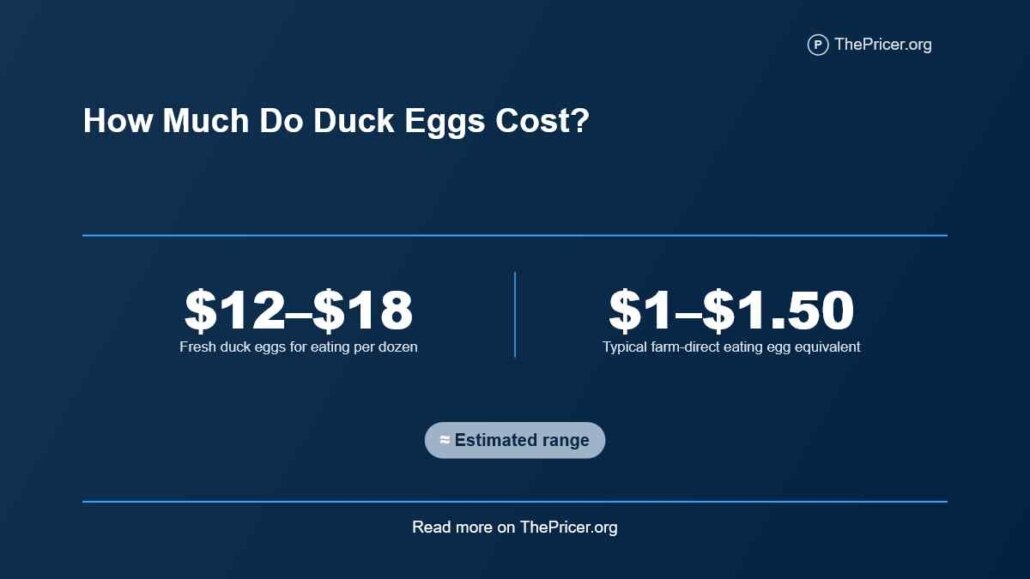
Fresh duck eggs for eating generally cost around $12 to $18 per dozen in current US farm-direct examples, equivalent to approximately $1 to $1.50 per egg. Some local sellers charge less, while specialty delivery and small-batch offerings can cost more. Fertile duck eggs for hatching belong to a different market, with current hatchery examples ranging from about $8 to $14 per egg in small quantities and rare varieties costing considerably more.
Buyers should distinguish table eggs intended for cooking from fertile eggs selected for incubation. Breed, quantity, shipping, availability, and seller type affect the purchase price. Duck eggs are also generally larger than chicken eggs, making the cost per edible portion a more useful comparison than price per shell alone.
Article Highlights
Jump to sections
- Current US farm examples put fresh eating duck eggs around $12 to $18 per dozen.
- Tyner Pond Farm advertises large pasture-raised duck eggs at $12 per dozen.
- Bear House Farm offers six duck eggs for eating at $8, equivalent to $16 per dozen.
- Metzer Farms lists Pekin hatching eggs at $9 each for orders of fewer than 30.
- Shipping and minimum-order requirements can substantially increase hatching-egg costs.
- Duck eggs contain more calories and fat per 100 grams than chicken eggs, but they are not a proven treatment for disease.
How Much Do Duck Eggs Cost?
Duck eggs are a specialty food rather than a product with a single national retail price. Direct-farm listings provide useful purchase examples, but individual prices depend on delivery territory and the quantity available.
Indiana’s pasture-raised duck egg listing advertises one dozen large eggs for $12. Its product page specifies local delivery or pickup, while also indicating that availability may be limited.
Bear House Farm’s duck egg price schedule lists six fresh table eggs for $8 and six Khaki Campbell fertile hatching eggs for $12. The farm explains that its small flock limits how rapidly orders can be filled.
| Duck egg offering | Published price | Purchase scope |
|---|---|---|
| Tyner Pond eating eggs | $12/dozen | Pasture-raised, local pickup or delivery |
| Bear House eating eggs | $8/6 eggs | Small-flock table eggs |
| Bear House hatching eggs | $12/6 eggs | Khaki Campbell, local farm offering |
| Metzer Pekin hatching eggs | $9/egg | Orders of 1–29 |
| Metzer Cayuga hatching eggs | $9.25/egg | Orders of 1–29 |
| My Pet Chicken assorted hatching eggs | $9.99/egg | Minimum six from one farm |
| My Pet Chicken Duclair hatching eggs | $12.99/egg | Breed-specific fertile egg |
These figures are advertised seller prices, not a statistically representative national average. Eating and hatching prices should not be combined to calculate one average duck egg cost. Both products come from ducks, but the purchase conditions and intended use differ.
Why Hatching Eggs Cost More
Fertile duck eggs are selected for customers planning to incubate them. They generally require careful collection, handling, packaging, and shipment. Buying an egg does not guarantee a successful hatch.
Metzer Farms’ published hatching egg schedule lists Pekin eggs at $9 each for orders of 1–29, falling to $6 for 30–124 and $3.50 for 125 or more. Cayuga eggs start at $9.25 and fall to $6.25 and $4.75 in the corresponding brackets.
This creates a substantial quantity discount. Thirty Pekin hatching eggs at $6 cost $180, whereas thirty eggs priced individually at $9 would cost $270. The difference is $90, or one-third of the small-order-price total. The comparison assumes the same breed and seller and excludes incubation equipment.
Breed-specific prices also vary. My Pet Chicken’s Duclair listing advertises fertile eggs at $12.99 each. This is a specific breed offer rather than evidence that all rare duck eggs command a particular premium.
The old article’s long breed table used 2023 prices that could not establish today’s hatchery market. Current supplier schedules are more useful because they identify the available breed, quantity brackets, and shipping conditions.
Shipping and Incubation Charges
Online hatching eggs involve costs that local table-egg purchases may avoid. Packaging and transport must protect the shells, and timing matters because the customer intends to incubate viable eggs.
My Pet Chicken’s assorted duck hatching offer lists $9.99 per egg, a six-egg minimum from the selected farm, and shipping of $19.99 for orders containing 6–12 eggs. Its displayed terms provide free shipping at 13 or more eggs.
At the six-egg minimum, the purchase would cost $59.94 for eggs plus $19.99 shipping, totaling $79.93. That is approximately $13.32 per egg delivered, before incubation equipment.
A single-egg advertised price therefore understates the cost of a small online hatching order by roughly 33% in this particular six-egg calculation.
Incubation equipment adds another expense. My Pet Chicken advertises a Maxi 24 Advance incubator at $349.99 on its product recommendations. A first-time buyer purchasing the six assorted eggs at the calculated delivered price and that incubator would spend approximately $429.92 before electricity, brooding equipment, feed, housing, or veterinary expenses.
The incubator can serve future batches, so its full purchase price should not be assigned to every subsequent hatch. Hatch success also remains uncertain. Anyone planning to raise ducks should account for the broader cost of keeping ducks, not only the eggs.
Are Duck Eggs More Expensive?
Duck eggs usually cost more per shell than ordinary chicken eggs because they are sold through a smaller specialty market. The comparison changes somewhat when size is considered.
One medium-to-large duck egg commonly weighs around 70 grams, while a large chicken egg is approximately 50 grams without its shell. On that basis, one duck egg provides about 40% more edible weight. Individual eggs can differ from these illustrative weights.
At a duck egg price of $1.25 and an assumed chicken egg price of $0.35, the duck egg is about 3.6 times as expensive per shell. Accounting for the 70-gram versus 50-gram portions, its effective cost per 50 grams is approximately $0.89, compared with $0.35 for the chicken egg.
The duck egg remains about 2.6 times more expensive on this matched-weight basis. The chicken egg price is a scenario assumption, not a current nationwide retail average.
This matters for baking. A recipe that uses eggs principally for liquid volume and structure may need fewer duck eggs. Substitution should follow total egg weight rather than an automatic one-for-one rule, especially in recipes where precise ingredient ratios affect the outcome.
Duck Egg Size and Nutrition
Duck eggs generally have larger yolks relative to their overall size and often produce a richer texture in baked goods. Shell color varies by breed and can include white, pale blue, greenish, and gray tones.
The USDA-linked duck egg nutrition record reports approximately 185 calories, 12.81 grams of protein, and 13.77 grams of fat per 100 grams of raw whole egg.
Because duck eggs tend to be larger, their total calories and fat per egg will often exceed those of a standard chicken egg. Proper comparison requires the same weight of edible egg, not a large duck egg against a smaller chicken egg.
Duck eggs also contain cholesterol. They should not be described as cholesterol-free, nor do their nutrient levels establish that they treat anemia, arthritis, cancer, hormonal conditions, or other diseases.

Consumers with dietary restrictions can evaluate duck eggs using the specific nutrition information and portion sizes relevant to their needs. Someone with a chicken egg allergy should not assume duck eggs are safe substitutes without appropriate medical guidance.
Where to Buy Duck Eggs
Local farms, farmers markets, community-supported agriculture programs, and specialty food suppliers are common purchase channels. Some supermarkets carry duck eggs, but availability can be irregular.
LocalHarvest’s online farm egg listings include duck egg offers from participating farms. One listing from The 607 CSA displays duck eggs within a $9.20 to $10.40 price range, although buyers must inspect the actual product size and options before comparing it with a dozen-egg carton.
Local pickup can eliminate shipping costs. Some farms sell by the half-dozen because their flocks do not produce enough eggs to supply larger orders consistently. Others accept advance reservations or limit sales to seasonal availability.
Buyers should check whether the eggs are for eating, whether the listed price covers six or twelve, and whether delivery is available in their area. Buying directly from a farm is not automatically cheaper than a retailer, especially when fuel and travel time are considered.
What Makes Duck Eggs Expensive?
Duck egg prices respond to seller scale, flock productivity, feed expenses, seasonal availability, and how the eggs are distributed. A small producer selling locally may have limited supply even when demand is consistent.
Hatching eggs introduce additional distinctions. Buyers may pay for a particular breed, breeding-stock characteristics, a narrow collection window, protective shipping, or a small order. Minimum quantities can determine the effective price more than the egg’s basic list price.
There are three different purchasing situations to consider. A local baker buying six table eggs may reasonably pay a higher per-egg rate to avoid waste. A household using duck eggs regularly may prefer a dozen from a nearby producer. A breeder ordering fertile eggs needs to evaluate shipping, viability, incubation equipment, and the cost of caring for the resulting birds.
The most economical choice depends on the purpose. Buying fertile eggs for ordinary cooking may add cost without providing a culinary benefit, while inexpensive table eggs cannot be assumed to be fertile or suitable for incubation.
Storage and Food Safety
Duck eggs must be handled as perishable food. The FDA’s consumer egg safety recommendations advise purchasing refrigerated, clean, uncracked eggs and storing them promptly at 40°F or below. The agency recommends using refrigerated shell eggs within three weeks for best quality.
Eggs should be cooked until their yolks and whites are firm. Foods prepared with eggs should be cooked thoroughly, and recipes containing raw or undercooked eggs should use appropriately treated eggs or pasteurized egg products where suitable.
The FDA’s safe food handling temperature chart identifies 160°F as the minimum internal temperature for egg dishes. Raw eggs and utensils that touch them should be kept separate from ready-to-eat foods.
People who are pregnant, older adults, young children, and individuals with weakened immune systems face greater consequences from foodborne illness. Duck eggs do not become safer through arbitrary shell washing or a prescribed boiling time that ignores the cooking outcome.
Safe preparation protects the investment in fresh eggs. A cracked or mishandled egg is not a bargain simply because its purchase price was low.
Buying Duck Eggs for Better Value
Compare prices using the same quantity and purpose. A half-dozen table-egg offer should be converted to a dozen-equivalent before comparing it with a dozen-egg carton. For hatching eggs, calculate the delivered price rather than relying on the single-egg listing.
When purchasing regularly, ask whether a local farm can supply recurring orders. That can help with meal planning, although regular availability and discounts should be confirmed rather than assumed.
Eggs that will not be used promptly can sometimes be frozen after removing them from their shells, following suitable food-safety practices. Freezing whole shell eggs is not recommended. Purchase quantities should still reflect actual consumption.
People exploring other unusual culinary eggs can compare ostrich egg prices. The product is much larger and belongs to a different price category, but it demonstrates why egg count, edible weight, and intended use must be considered together.
Makes sense if
- You want duck eggs for their baking properties or richer yolk.
- A local seller supplies fresh eggs without excessive delivery costs.
- You can use the purchased quantity within an appropriate storage period.
- You are buying fertile eggs with a suitable incubation and animal-care plan.
Does not make sense if
- You only need the cheapest everyday source of egg protein.
- Shipping exceeds the value of a small table-egg order.
- You are paying for fertile hatching eggs when ordinary eating eggs would suffice.
- You lack the equipment or facilities needed to hatch and raise ducks.
Answers to Common Questions
How much does one duck egg cost?
Current farm examples put duck eggs for eating at approximately $1 to $1.50 each. Fertile hatching eggs may cost considerably more, depending on breed and seller.
How much does a dozen duck eggs cost?
A useful US farm-direct planning range is approximately $12 to $18 per dozen for eating eggs. Availability and delivery costs can change the final price.
Are duck eggs better for baking?
Their relatively large yolks and different proportions of egg white and yolk can affect richness and structure. Results depend on the recipe. Precise baking substitutions should be based on egg weight.
Are duck eggs safe to eat?
Yes, when properly sourced, stored, and cooked. Refrigerate them promptly, avoid cracked eggs, and cook egg dishes thoroughly. Raw or undercooked eggs carry foodborne illness risks.
Can eating duck eggs cure medical conditions?
No reliable clinical evidence establishes duck eggs as a treatment for cancer, arthritis, hormonal disorders, or other diseases. They are food, not medical therapy.
Disclosure: Educational content, not financial advice. Prices reflect public information as of the dates cited and can change. Confirm current rates, fees, taxes, and terms with official sources before purchasing. See our methodology and corrections policy.