
How Much Does it Cost to Move a Hot Tub?
Updated on | Researched and reviewed by Alec Pow, Founder & Pricing Investigator
Prices, claims, and calculations checked against 9 cited sources. See our research methodology and corrections policy.
Moving a hot tub typically costs $300 to $1,200 for a straightforward professional move within the same property or local area. A same-yard relocation across a flat, accessible surface may cost $200 to $600, while moving the spa between nearby homes generally costs $500 to $1,500.
Projects involving stairs, narrow gates, steep slopes, fence removal, difficult lifting, or a crane can cost $1,000 to $4,000+. A long-distance move or relocation of a large swim spa may reach $2,000 to $6,000+. These figures usually cover only the physical move, not every expense required to reconnect and operate the spa at its new location.
The complete relocation may also require a licensed electrician, a concrete or gravel pad, deck reinforcement, drainage work, access modifications, a replacement cover, startup chemicals, or repairs discovered after the move. With those costs included, an ordinary hot tub relocation can total $1,500 to $5,000+, even when the mover’s own charge is under $1,000.
Article Highlights
Jump to sections
- Same-property hot tub moves usually cost $200 to $600.
- A straightforward local move generally costs $500 to $1,500.
- Difficult-access or crane-assisted moves can cost $1,000 to $4,000+.
- Electrical disconnection and reconnection may add $500 to $2,000+.
- A new pad or foundation can add $500 to $4,000+.
- The complete relocation cost often reaches $1,500 to $5,000+.

How Much Does It Cost to Move a Hot Tub?
The amount charged by a hot tub mover depends on the dry weight and dimensions of the spa, distance between properties, access at both locations, labor, equipment, and whether the crew must lift the tub over a house, fence, retaining wall, or other obstacle. The following ranges are suitable for preliminary budgeting.
| Hot tub moving project | Typical cost | What the price may include |
|---|---|---|
| Same-property repositioning | $200 to $600 | Short move over level, open ground |
| Straightforward local move | $500 to $1,200 | Loading, nearby transport, unloading |
| Local move with access problems | $800 to $2,000+ | Stairs, slopes, tight turns, gate work |
| Long-distance hot tub move | $1,500 to $4,000+ | Dedicated transport, mileage, crew travel |
| Crane-assisted move | $800 to $3,000+ | Crane, operator, setup, rigging, minimum hours |
| Swim spa or extreme-access move | $2,000 to $6,000+ | Heavy equipment, permits, specialized transport |
| Electrical work | $500 to $2,000+ | Disconnect, reconnect, conduit, GFCI work |
| New pad or foundation | $500 to $4,000+ | Gravel base, prefabricated pad, or concrete slab |
Angi’s 2026 moving-cost guide places the average professional move around $600, with most jobs between $300 and $1,200. HomeGuide lists same-property moves near $150 to $400 and cross-town moves near $300 to $1,000. Current manufacturer guidance from Sundance Spas places professional local relocation around $400 to $1,200.
These ranges refer mainly to ordinary portable spas. Large swim spas, severely restricted access, old or damaged cabinets, and moves across several states require individually prepared quotes.
Move-Only vs Complete Relocation
A quote from a specialist mover may cover only preparing the empty spa for transport, moving it onto a truck or trailer, securing it, transporting it, and placing it at the new location. It may not include draining, electrical work, a new foundation, filling, startup, water treatment, leak testing, or disposal of the old pad.
This distinction explains why a mover may quote $750 while the completed project ultimately costs several thousand dollars. A homeowner moving a spa to a new house may also need to pay for an electrician, concrete contractor, landscaper, fence company, crane operator, or deck engineer.
Consider a straightforward local relocation with a mover’s fee of $850. Electrical disconnection and reconnection cost $650, a compacted gravel pad costs $1,200, removal and reinstallation of the cover lifter costs $150, and startup supplies cost $100. The complete cost is:
$850 + $650 + $1,200 + $150 + $100 = $2,950.
The written estimate should identify exactly where the mover’s responsibility ends. Some crews place the spa and leave before electrical connection. Others offer draining, winterization, startup, or equipment inspection as optional services. Licensed electrical work should not be assumed to be part of a general moving contract.
Hot Tub Size, Dry Weight
Movers need the exact spa model, dry weight, dimensions, and allowable moving orientation. Seat count alone is not a reliable weight estimate. Two six-person spas may differ by hundreds of pounds because of shell construction, cabinet framing, pumps, insulation, water features, and equipment.
Current Hot Spring specifications illustrate the variation. The three-seat Jetsetter weighs approximately 500 pounds dry. The six-seat Vanguard weighs about 710 pounds dry, while the seven-seat Grandee weighs approximately 790 pounds dry. The Hot Spring Pulse reaches about 1,015 pounds empty.
The spa must normally be fully drained before moving. Water weighs approximately 8.34 pounds per gallon. Leaving only 50 gallons inside adds:
50 × $8.34 = 417 pounds.
Retained water also shifts while the spa is tilted and can enter plumbing or equipment areas. The original article’s instruction to partially drain a 1,000-pound spa was unsafe and has been removed.
Filled weight matters at the destination. The Grandee weighs approximately 5,810 pounds when filled and occupied. The mover handles the dry weight, but the pad, patio, or deck must safely support the much larger operating load.
Access, Gates, Slopes
Access conditions can matter more than distance. A crew may move a spa across an open driveway in less than an hour but spend several hours navigating a narrow side yard, sharp corner, elevated deck, soft lawn, retaining wall, or steep hill.
Before requesting quotes, measure the spa’s width, length, and height and then measure every gate, doorway, turn, roof overhang, deck opening, and pathway at both properties. Include photographs and video showing slopes, stairs, landscaping, utilities, air-conditioning equipment, and overhead power lines.
A fence panel or gate may need to be removed when the spa cannot pass through. Landscaping, railings, pergolas, or pavers may also need temporary alteration. Such work can add several hundred to several thousand dollars, especially when materials must be rebuilt after the move.
A crane may be necessary when the spa sits behind a house, on an elevated terrace, inside a courtyard, or beyond an inaccessible retaining wall. Current pricing from Rigging Force places many residential hot tub crane lifts between $300 and $1,500, with standard lifts frequently around $500 to $800. Difficult reach, large cranes, road occupation, minimum dispatch hours, permits, and traffic control can raise the total to $1,500 to $3,000+.
Electrical Disconnection
Most portable hot tubs are self-contained and are not permanently connected to household plumbing. They are filled with a garden hose and drained through an outlet or pump. The important technical disconnection is generally electrical.
Many full-size spas require a dedicated 240-volt circuit with GFCI protection. Jacuzzi’s electrical guidance states that most full-size Jacuzzi hot tubs require a dedicated 240-volt circuit with a 50-amp GFCI breaker installed by a licensed electrician. Requirements vary by model, manufacturer, and local code.
A simple disconnection and reconnection using a suitable existing circuit may cost approximately $500 to $1,000. Moving the disconnect, extending conduit, trenching, installing a new circuit, or upgrading the electrical panel can raise the cost to $1,000 to $3,000+.
The homeowner should not assume that the hot tub moving crew is qualified or authorized to perform this work. The moving contract should state whether an electrician is included, subcontracted, or the homeowner’s responsibility.
The electrician should have the exact manufacturer wiring diagram before beginning. Power should not be restored until the spa is placed correctly, plumbing has been inspected, and the tub has been filled according to manufacturer instructions. Running pumps or heaters without adequate water can damage the equipment.
Pad, Slab, and Deck Prep
The new location must be level, stable, properly drained, and able to support the filled spa. Suitable foundations may include reinforced concrete, compacted crushed stone, a manufacturer-approved prefabricated spa pad, or a structurally evaluated deck.
Jacuzzi’s 2026 installation guide places a reinforced four-inch concrete slab around $600 to $2,000+, a reinforced wood or composite deck around $800 to $3,000+, and a prefabricated pad over compacted gravel around $200 to $600. Actual prices can be higher when excavation, drainage, difficult access, demolition, or engineering is required.
A basic gravel pad may cost $500 to $2,500, while a professionally installed concrete slab commonly costs $1,000 to $4,000+ after excavation, forming, reinforcement, concrete delivery, and finishing. ThePricer’s guide to concrete slab costs explains how thickness, reinforcement, and access affect the total.
An existing deck should not be assumed strong enough because it supports people and outdoor furniture. A filled spa can weigh 4,000 to 6,000 pounds or more across a relatively small area. Structural inspection, additional beams, posts, footings, or complete reinforcement may cost $1,500 to $10,000+.
The pad should be completed before moving day. A crew that arrives before the site is ready may charge waiting time, leave the spa temporarily staged, or require a second visit.
How Professionals Move a Hot Tub
A professional relocation starts with model identification and access planning rather than lifting. The mover should receive the spa’s specifications, photographs of both properties, travel distance, surface conditions, and information about stairs, gates, slopes, and overhead obstacles.
The spa is turned off, electrically disconnected, and completely drained. The cover, cover lifter, steps, handrails, loose accessories, and detachable components are removed and labeled. In freezing conditions, remaining water may need to be blown or vacuumed from the plumbing to prevent damage.
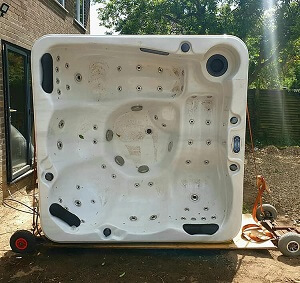
The crew then uses equipment appropriate for the model and access route. This may include spa dollies, sleds, air cushions, powered carts, moving blankets, lifting straps, ramps, blocking, a forklift, telehandler, or crane. A hydraulic jack may be used to create clearance for equipment, but it is not by itself a complete moving method.
The spa is supported according to manufacturer guidance and secured on a suitable truck or trailer. At the destination it is placed on the prepared pad and leveled. Electrical reconnection, filling, startup, leak inspection, and water balancing occur afterward according to the agreed scope.
Most portable acrylic spas are moved substantially intact. Shells, frames, plumbing, and insulation should not be casually dismantled merely to reduce weight.
Used or Older Hot Tub
Relocating a secondhand spa introduces financial risks that do not apply to a known working unit. Whenever possible, inspect the hot tub while it is filled, heated, and operating before agreeing to buy or move it. Once drained, slow leaks, heater problems, weak pumps, and control faults can be difficult to identify.
Check the acrylic shell for cracks, blistering, discoloration, or previous repairs. Inspect the frame for rot or corrosion, the cabinet for brittleness, and the foam insulation for signs of water saturation. Test the pumps, heater, controls, jets, lights, and water-care system. Confirm that replacement parts remain available for the model.
An older spa may not tolerate being tilted if its frame has deteriorated. Movers may refuse the job or exclude damage caused by pre-existing weakness. The written quote should disclose the spa’s age, condition, known leaks, repairs, and whether cabinet panels can be removed safely.
Moving can also reveal plumbing leaks after the shell has flexed during transport. Budget at least $200 to $1,000+ for minor fittings, pump seals, plumbing repairs, or troubleshooting on an older unit. A damaged cover may add several hundred dollars.
The manufacturer’s warranty may apply only to the original purchaser or original installation address. Moving does not automatically void every warranty, but damage caused by improper transport, modification, installation, or electrical work may be excluded.
DIY Hot Tub Moving
A DIY move is not free. Sundance estimates equipment and truck rental at approximately $250 to $600 before fuel, helpers, insurance, straps, ramps, dollies, electrician costs, pad work, or damage. A long or complicated move can cost nearly as much as hiring a specialist.
Actual risks include crushing injuries, strained backs, trapped hands, a dropped shell, broken plumbing unions, cracked frames, scraped paving, damaged siding, an overloaded trailer, and insecure highway transport. The danger comes from the spa’s rigid size, poor handholds, high center of gravity when tilted, and limited ability to stop the load if it begins to fall.
Crew size cannot be determined by a universal rule such as “six people for a 1,000-pound tub.” Two or three trained movers using a powered spa dolly may handle a project more safely than six uncoordinated helpers lifting manually. Equipment, access, load control, and an experienced crew leader matter more than adding hands.
Homeowners should not attempt electrical disconnection or reconnection unless legally qualified. They should also avoid simplified internet methods involving improvised pipes, ordinary furniture dollies, uncontrolled ramps, or partially filled spas.
DIY is most defensible for a small, light spa moved a short distance over level private property using manufacturer-approved methods and suitable equipment. Professional help is the safer choice for full-size acrylic spas, stairs, road transport, narrow access, decks, and any crane work.
Three Complete Moving Budgets
Same-yard repositioning: A specialist moves a drained spa 40 feet across level paving for $400. Electrical disconnection and reconnection cost $500, and replacement leveling shims plus startup chemicals add $100. The total is:
$400 + $500 + $100 = $1,000.
Local move with a new foundation: The moving crew charges $850. Electrical work costs $650, a compacted gravel foundation costs $1,200, fence-panel removal and replacement cost $350, and startup supplies cost $100. The complete relocation costs:
$850 + $650 + $1,200 + $350 + $100 = $3,150.
Crane-assisted backyard move: The base moving service costs $900, a crane lift costs $1,200, access coordination costs $250, electrical work costs $700, and a new concrete slab costs $2,000. The total reaches:
$900 + $1,200 + $250 + $700 + $2,000 = $5,050.
These examples show why a $600 mover’s quote should not be presented as the total cost of making the spa operational at its new location.
When Moving Is Worth the Cost
Moving may not make financial sense when the spa is old, inefficient, badly damaged, difficult to access, or worth less than the relocation and expected repair bill. Used hot tubs often sell for a small fraction of their original retail price because buyers must assume the cost and risk of removal.
Suppose moving and reinstalling a 12-year-old spa costs $4,500. The cover, pump, and control system are expected to need another $1,500 in repairs. The homeowner would commit:
$4,500 + $1,500 = $6,000.
If a suitable replacement costs $8,000, keeping the old spa requires 75% of the replacement price while retaining an aging shell, plumbing system, frame, insulation, and heater. Replacement may offer the stronger value.
On the other hand, spending $2,000 to move a five-year-old premium spa worth more than $12,000 can be reasonable when it is operating properly and the new site is ready.
Removal and disposal should be priced as a third option. A mover, dealer, or junk-removal company may charge several hundred to more than $1,000 depending on access and whether the spa must be cut apart. Compare those expenses with ThePricer’s guide to hot tub removal costs.
How to Compare Moving Quotes
Provide every bidder with the same information, including the manufacturer, model, dimensions, dry weight, age, condition, pickup and delivery addresses, travel distance, access photographs, stairs, slopes, gate widths, and foundation type. A mover cannot prepare a reliable quote from seat count alone.
The written quote should state whether it includes draining, accessory removal, electrical coordination, loading, transportation, unloading, placement, leveling, crane scheduling, fence work, travel time, fuel, tolls, permits, insurance, startup, and disposal of packing materials.
Ask for proof of general liability, commercial auto coverage, workers’ compensation where required, and insurance covering the spa while it is in the company’s care. Confirm whether internal plumbing, existing cabinet deterioration, hidden frame damage, and post-move leaks are excluded.
Do not assume the mover provides an unlimited warranty. The contract should explain what happens if the shell, cabinet, property, driveway, fence, or access route is damaged. It should also identify the claims process and any declared-value limits.
Compare at least three specialist quotes, but do not choose only by price. Experience with hot tubs, suitable equipment, route planning, and clearly defined responsibility are more important than an arbitrary crew size.
What We Verified
We checked current 2026 moving prices from Angi, HomeGuide, Sundance Spas, specialist movers, and crane-service guidance. We verified current dry and filled weights using Hot Spring model specifications and reviewed hot tub installation, foundation, and electrical guidance from Jacuzzi.
We removed the unsafe instruction to partially drain the spa, the assumption that portable tubs require household plumbing disconnection, the universal $50 to $150 moving-permit claim, and the arbitrary rule requiring a specific number of movers. We also separated the mover’s fee from concrete, electrical, access, crane, startup, and repair costs and preserved the existing image and relevant ThePricer links.
Answers to Common Questions
How much does it cost to have a hot tub moved?
A straightforward professional move generally costs $300 to $1,200. Local transport with difficult access commonly costs $800 to $2,000+, while crane-assisted or long-distance moves can cost several thousand dollars.
How much does it cost to move a hot tub across a yard?
A same-property move over a flat and accessible route typically costs $200 to $600. Stairs, slopes, soft ground, narrow gates, and landscaping can increase the price.
Does a hot tub need to be completely drained before moving?
Yes, portable acrylic hot tubs should generally be completely drained before relocation. Even 50 gallons of retained water adds approximately 417 pounds and creates an unstable moving load.
Can ordinary household movers move a hot tub?
Some can, but confirm that they have specific spa-moving experience, suitable equipment, commercial insurance, and a written plan for access and transport. A specialist is preferable for heavy or difficult spas.
Do hot tub movers reconnect the electricity?
Not necessarily. Many movers only transport and place the spa. A licensed electrician may need to disconnect and reconnect the dedicated circuit and GFCI equipment.
How much does a crane add to a hot tub move?
A straightforward residential crane lift may add approximately $500 to $1,500. Long reach, minimum dispatch hours, street occupation, traffic control, or larger equipment can raise the charge to $1,500 to $3,000+.
Is it worth moving an old hot tub?
Compare relocation, installation, and expected repair costs with the spa’s present condition and replacement price. Moving is less attractive when the combined commitment approaches 60% to 75% of the cost of a newer unit.
Disclosure: Educational content, not financial advice. Prices reflect public information as of the dates cited and can change. Confirm current rates, fees, taxes, and terms with official sources before purchasing. See our methodology and corrections policy.