
How Much do Potato Chips Cost?
Updated on | Written by Alec Pow
This article was researched using 14 sources. See our methodology and corrections policy.
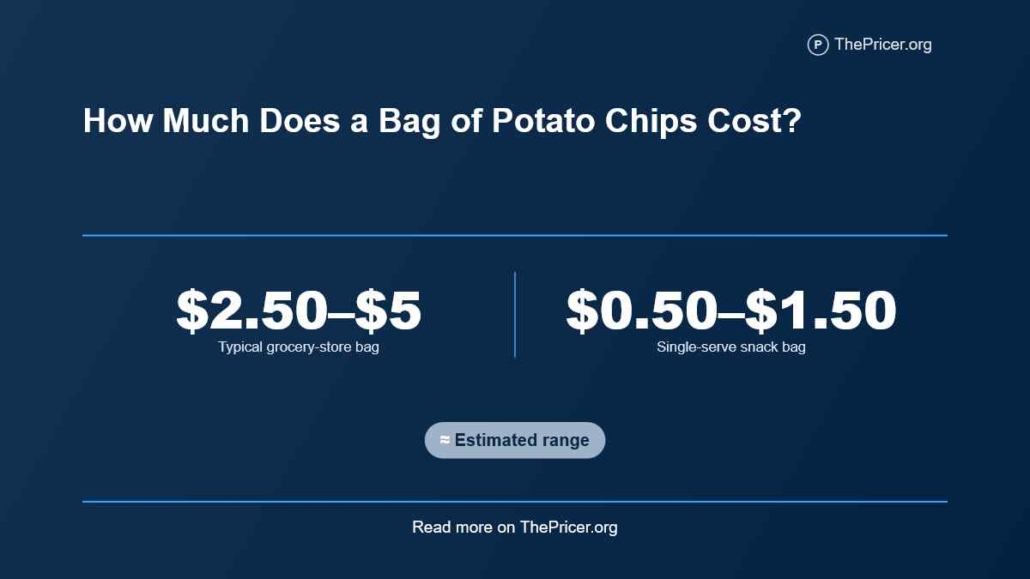
A bag of potato chips typically costs about $2.50 to $5 at a U.S. grocery store in 2026, although small snack bags can cost around $0.50 to $1.50 each in multipacks and premium or oversized bags can reach $6 to $8 or more. The price depends heavily on bag size, brand, flavor, store, and whether the chips are sold individually, as a family-size bag, or in a single-serve multipack.
Price per ounce tells a more useful story than the sticker price. Current examples range from about 19 cents per ounce for Walmart’s Great Value party-size chips to around 31 cents per ounce for Lay’s Classic, 47 cents per ounce for Ruffles Original, and roughly 50 cents per ounce for Cape Cod Original Kettle Chips.
Article Highlights
Jump to sections
- Most regular grocery-store bags cost about $2.50–$5.
- Small individual bags typically cost $0.50–$1.50 each when bought in multipacks.
- Value-brand party bags can cost under $0.20 per ounce.
- Major national brands often cost around $0.30–$0.50 per ounce.
- Premium kettle, avocado-oil, or specialty chips can cost $0.50–$0.75+ per ounce.
- Multipacks frequently cost more per ounce than one large bag.
- The BLS still tracks potato chips as an average retail food-price category on a 16-ounce basis.
How Much Does a Bag of Potato Chips Cost?
Current retail listings show that an ordinary bag of chips no longer has one useful national price.
| Example | Current Price | Price Per Ounce |
|---|---|---|
| Great Value Lightly Salted Wavy, 13 oz | $2.50 | 19.2¢/oz |
| Lay’s Classic, 8 oz | $2.50 | 31.3¢/oz |
| Ruffles Original, 8.5 oz | $3.97 | 46.7¢/oz |
| Cape Cod Original Kettle, 8 oz | $4.00 | 50.0¢/oz |
These prices were checked against current Walmart listings for Great Value wavy chips, Lay’s Classic, Ruffles Original, and Cape Cod Original.
The comparison is revealing: the Cape Cod bag costs only $1.50 more than the Great Value bag, but it contains 5 fewer ounces. On a unit-price basis, the premium product costs more than 2.6 times as much per ounce.
Price by Bag Size
A useful 2026 planning range looks like this:
| Package Size | Typical Price |
|---|---|
| 0.75–1.5 oz snack bag | $0.50–$1.50 each |
| 5–8 oz regular bag | $2.50–$5 |
| 8–13 oz family / party bag | $3–$6 |
| Premium specialty bag | $4–$8+ |
| 30–50 count multipack | $20–$35+ (at $30 per hour, earning that amount would take about 0.7 to 1.2 hours of work, before taxes) |
A large bag often gives the lowest cost per ounce. A small bag can look cheaper at checkout while actually costing two or three times more for the same amount of food.
Multipack Cost
Single-serve bags are convenient for lunches, portion control, events, and vending, but convenience has a price.
Walmart currently lists a 40-count Ruffles Original multipack around $30.57 (about 1 hour of work at $30 per hour). Because each bag contains about 1 ounce, that works out to roughly:
$30.57 ÷ 40 = $0.76 per 1-ounce bag
Compare that with the regular 8.5-ounce Ruffles bag at $3.97:
$3.97 ÷ 8.5 = about $0.47 per ounce
The individually wrapped format therefore costs around 62% more per ounce in this example.
A mixed Frito-Lay variety pack can be somewhat cheaper. A current 40-count Ruffles/Doritos pack is about $23.79, or roughly 59.5 cents per ounce, still above many large-bag prices.
National Average
The U.S. Bureau of Labor Statistics still tracks potato chips as a specific grocery-price category.
Its Average Price Data program defines the series as the cost of potato chips per 16 ounces, regardless of flavor, package size, or style.
Recent BLS regional tables put the U.S. 16-ounce equivalent in the neighborhood of $6.50. That does not mean every physical 16-ounce bag costs exactly $6.50. BLS converts different package sizes and products onto a standardized 16-ounce basis so prices can be compared over time.
This also explains why an 8-ounce $4 bag effectively corresponds to about $8 per 16 ounces, while a $2.50 13-ounce value bag corresponds to just over $3 per 16 ounces.
Worked Basket Example
Suppose someone wants approximately 40 ounces of chips for a party.
Five 8-ounce Cape Cod bags at $4 each would cost:
5 × $4 = $20 (about 40 minutes at $30 per hour)
Four 13-ounce Great Value bags at $2.50 would provide 52 ounces and cost:
4 × $2.50 = $10
The store-brand option provides 12 more ounces for $10 less.
For a party where brand preference is not important, unit price can therefore cut the chip bill in half.
Why Brands Cost More
Brand is one of the largest price drivers.
Lay’s, Ruffles, Cape Cod, Kettle Brand, and other national labels spend more on product development, flavor varieties, advertising, distribution, and packaging than most store brands.
That does not automatically make the chips objectively better. The premium is partly paying for brand recognition, a consistent flavor profile, and wider availability.
Store brands can use similar base ingredients at a lower cost because they do not carry the same national marketing expense.
Kettle Chips
Kettle-cooked chips usually cost slightly more than conventional thin potato chips.
Cape Cod’s current product information describes its process as thick-slicing potatoes and kettle cooking them in batches. Its classic recipe uses potatoes, vegetable oil, and sea salt.
A current 8-ounce Cape Cod Original bag is about $4, versus $2.50 for an 8-ounce Lay’s Classic bag at the same retailer.
That is a premium of:
($4 – $2.50) ÷ $2.50 = 60%
Buyers are paying for the brand and kettle-style texture, not simply for more food.
Specialty Oils
Premium ingredients can push the unit cost higher still.
For example, current retail listings for kettle chips cooked in avocado oil can approach $0.75 per ounce, compared with roughly $0.20 to $0.50 for many conventional potato chips.
A 5-ounce specialty bag at 75 cents per ounce costs about:
5 × $0.75 = $3.75
That sounds close to a $4 regular bag, but the regular bag may contain 8 ounces. The specialty product is therefore significantly more expensive by weight.
Ingredients
Basic potato chips are surprisingly simple.
Lay’s current Classic Potato Chips are marketed as containing only potatoes, oil, and salt.
Flavored chips can contain seasonings, dairy ingredients, sugar, acids, natural or artificial flavors, spice blends, and other ingredients depending on the recipe.
Ruffles offers a wide range of current flavors through its product catalog, including Original, Cheddar & Sour Cream, Sour Cream & Onion, barbecue variations, queso, jalapeño ranch, and Flamin’ Hot varieties.
Nutrition
Potato chips should not be treated as nutritionally equivalent to plain potatoes simply because potatoes are the first ingredient.
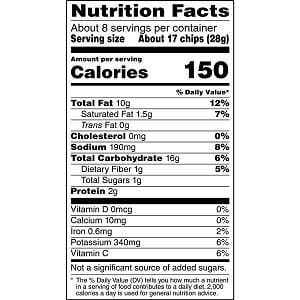
Cape Cod’s Original single-serve 28-gram bag currently lists 140 calories, 8 grams of fat, 70 milligrams of sodium, 16 grams of carbohydrate, and 2 grams of protein.
The U.S. Department of Agriculture also distinguishes snack-type potato products from ordinary vegetables in its school meal guidance, where potato chips do not count toward the vegetable component.
The most useful comparison for shoppers is the Nutrition Facts panel on the exact flavor being purchased because sodium and fat can differ substantially between varieties.
Trans Fat
The old advice to avoid potato chips containing partially hydrogenated oil is historically sensible but dated as a mainstream shopping concern.
The FDA determined in 2015 that partially hydrogenated oils, formerly the main source of artificial trans fat in processed foods, were no longer generally recognized as safe. The FDA phaseout ultimately removed PHOs from ordinary U.S. food production, with final transition deadlines completed years ago.
Shoppers should still read nutrition labels, but saturated fat, sodium, calories, portion size, and overall dietary pattern are now more relevant than hunting for PHOs in a normal modern bag of chips.
Lightly Salted Options
Consumers watching sodium can compare reduced-sodium versions rather than assuming all chips contain the same amount of salt.
Lay’s current Lightly Salted Potato Chips are advertised with 50% less sodium than Lay’s Classic.
This is a better example of a meaningful nutrition comparison than labeling one entire brand “healthy” or “unhealthy.”
Are Baked Chips Healthier?
Baked chips may contain less fat than conventional fried versions, but that does not automatically make every baked chip lower in calories or sodium.
Nutrition varies by recipe, serving size, and seasoning. The correct comparison is between two specific Nutrition Facts labels rather than assuming that the word “baked” guarantees a better nutritional profile.
The same principle applies to kettle chips. Kettle cooking changes texture and preparation style, but “kettle cooked” is not itself a health claim.
The Potato Chip Origin Story
The famous story says George Crum, also known as George Speck, created potato chips in Saratoga Springs in 1853 after an unhappy diner repeatedly complained that his fried potatoes were too thick.
According to the legend, Crum sliced the potatoes paper-thin, fried them until crisp, heavily salted them, and was surprised when the customer loved them.
However, the story should be presented as legend rather than established history.
The Smithsonian’s history of the potato chip notes that recipes for sliced fried potatoes existed as early as 1817 and that another Saratoga cook was praised for fried potatoes in 1849.
History.com goes further, noting that historian T.J. Stiles found no evidence that Cornelius Vanderbilt was the complaining diner.
Crum clearly became famous for Saratoga chips and helped popularize them, but the neat “angry chef invents the chip for Vanderbilt” story is not well supported.
Hidden Price
The hidden price in potato chips is usually air and package convenience.
Bags are intentionally filled with protective gas so fragile chips are less likely to be crushed. That means the physical size of the bag is a poor way to judge value.
Always compare the net weight and unit price.
A $4 eight-ounce bag costs 50 cents per ounce. A $3 thirteen-ounce bag costs only about 23 cents per ounce. The second bag is 25% cheaper at checkout and more than 50% cheaper by weight.
Single-serve packaging creates the same effect. The buyer is paying for dozens of bags, printing, sealing, boxes, and convenience rather than only the potatoes inside.
Ways to Spend Less
Compare price per ounce. This is much more useful than comparing bag prices.
Try store brands. Current examples show that a store-brand party bag can cost less than 20 cents per ounce versus 30 to 50 cents for major brands.
Buy large bags for parties. Individual packs usually cost more by weight.
Use multipacks when portioning matters. They cost more per ounce, but they can prevent repeatedly opening a large bag and may be useful for school or work lunches.
Watch promotions rather than stockpiling blindly. Chips are frequently discounted, but buying five bags is not a saving if several go stale before they are eaten.
You might also like our guides to the cost of potatoes, sweet potatoes, and french fries.
What We Verified
We checked current 2026 retail listings rather than retaining older generic $3-to-$7 estimates. Current examples range from about $2.50 for an 8-ounce Lay’s Classic bag and $2.50 for a 13-ounce Great Value bag to around $4 for 8 ounces of Cape Cod kettle chips.
We also verified that the Bureau of Labor Statistics still publishes a standardized potato-chip average-price series based on a 16-ounce equivalent.
We checked ingredient and nutrition claims against current manufacturer information and FDA guidance, including the removal of partially hydrogenated oils from normal U.S. food production.
Answers to Common Questions
How much does a bag of potato chips cost in 2026?
Most standard grocery-store bags cost roughly $2.50 to $5. Premium and extra-large bags may cost $6 to $8 or more.
How much does an 8-ounce bag cost?
Current examples range from about $2.50 for Lay’s Classic to around $4 for Cape Cod Original.
How much are individual chip bags?
Multipack snack bags typically work out to around $0.50 to $1.00 each, depending on brand, quantity, and sale price.
Are store-brand chips cheaper?
Usually. A current Great Value 13-ounce bag costs about $2.50, or roughly 19 cents per ounce, significantly below many major brands.
Are multipacks cheaper?
Usually not on a per-ounce basis. They are primarily a convenience and portion-control product.
Did George Crum invent potato chips?
He helped popularize Saratoga chips, but historians have documented fried sliced-potato recipes from before 1853, and the famous Cornelius Vanderbilt story is disputed.
Are kettle chips healthier than regular chips?
Not necessarily. Kettle cooking primarily changes preparation and texture. Compare calories, fat, sodium, and serving size on the specific labels.
Disclosure: Educational content, not financial advice. Prices reflect public information as of the dates cited and can change. Confirm current rates, fees, taxes, and terms with official sources before purchasing. See our methodology and corrections policy.