
How Much Do Sweet Potatoes Cost?
Updated on | Written by Alec Pow
This article was researched using 14 sources. See our methodology and corrections policy.
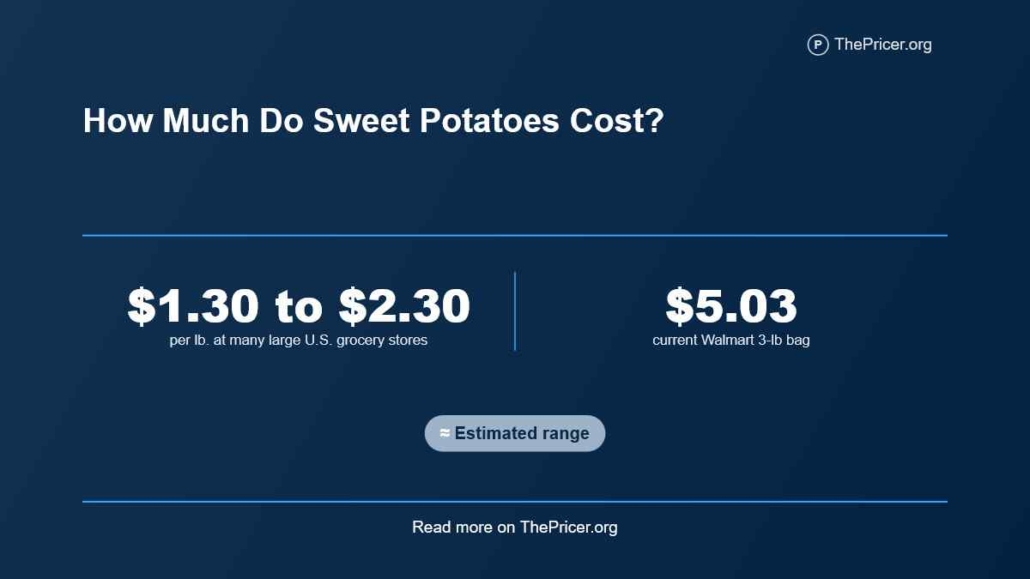
Fresh sweet potatoes cost about $1.30 to $2.30 per pound at many large U.S. grocery stores in late August 2026, with conventional varieties usually near the lower half of that range and organic or specialty varieties often higher. Current examples include conventional sweet potatoes at $1.39 per pound at Kroger and loose sweet potatoes at $1.88 per pound at Walmart. Three-pound bags commonly land around $4 to $5.50.
The cheapest sticker price is not always the cheapest food. Bagged sweet potatoes can beat the loose price per pound, but buying more than you will use turns the discount into waste. Variety matters too. Japanese, purple, white, red, organic, and premium packed sweet potatoes can cost substantially more than standard orange types.
Sweet potatoes are sold by the pound, by the piece, and in fixed-weight bags. The useful comparison is the price per pound for the variety and quantity you will actually eat, not the advertised package price alone.
Article Highlights
Jump to sections
- Current conventional grocery examples run from about $1.39 to $1.88 per pound.
- Walmart’s current three-pound bag costs $5.03, or $1.68 per pound, compared with $1.88 per pound for loose sweet potatoes.
- A medium sweet potato commonly weighs about 0.25 to 0.33 pound, putting one medium root around $0.42 to $0.55 at a $1.68-per-pound bag price.
- At one current Kroger location, organic Gold Jewel sweet potatoes are $1.99 per pound compared with $1.39 per pound for conventional sweet potatoes.
- Wholesale 40-pound cartons can cost less than $0.50 per pound for some orange types, but terminal-market prices are not consumer retail prices.
- Commercial storage near 55°F can keep properly cured sweet potatoes marketable for months, while colder storage can cause chilling injury.
How Much Do Sweet Potatoes Cost?
| Sweet potato purchase | Current price example | Effective price |
|---|---|---|
| Kroger conventional loose | About $1.04 each | $1.39 per lb. |
| Walmart conventional 3-lb bag | $5.03 | $1.68 per lb. |
| Walmart conventional loose | About $1.97 each | $1.88 per lb. |
| Kroger Organic Gold Jewel | About $1.39 each | $1.99 per lb. |
| Kroger organic white | About $1.15 each | $2.29 per lb. |
| Target fresh sweet potato | $1.59 each | Sold by piece in the current listing |
These are snapshots rather than a national fixed tariff. A current Kroger fresh sweet potato listing shows conventional roots at $1.39 per pound, Organic Gold Jewel at $1.99 per pound, and organic white sweet potatoes at $2.29 per pound for the selected store. Prices can change when the store location changes.
Walmart currently lists a three-pound sweet potato bag at $5.03, equal to $1.68 per pound. Its loose sweet potato listing shows an estimated $1.97 each and $1.88 per pound. Target currently lists a fresh sweet potato at $1.59 each.
What You’re Buying
Sweet potatoes are storage roots of Ipomoea batatas. They are not the same crop as ordinary white potatoes, and U.S. products labeled “yams” are often orange-fleshed sweet potatoes rather than true botanical yams. Grocery stores commonly sell orange, white, Japanese, red-skinned, and purple-fleshed types. The North Carolina variety guide describes hundreds of types, with differences in flesh color, moisture, sweetness, and texture.
Those differences matter to price because specialty varieties are not direct substitutes for the standard orange roots sold in large bags. A shopper buying Japanese sweet potatoes for a dry, chestnut-like texture may pay more than someone buying orange sweet potatoes for mashing or roasting.
Nutrition is a feature of the food, not a reason to turn a price page into medical advice. The NIH vitamin A reference table lists one baked sweet potato with skin at 1,403 mcg RAE of vitamin A, or 156% of the Daily Value. That is a useful nutrient fact without claiming that sweet potatoes prevent or treat disease.
Bagged vs Loose
Walmart’s current bag and loose prices create a clean comparison. Three loose pounds at $1.88 per pound cost $5.64. The three-pound bag costs $5.03. Buying the bag saves $0.61, or about 10.8%, if all three pounds get eaten.
The discount disappears quickly if part of the bag spoils. At the loose rate of $1.88 per pound, $5.03 buys about 2.68 pounds. That means wasting more than about 0.32 pound, roughly 5.2 ounces, from the three-pound bag wipes out its entire price advantage.
Size gives another useful way to view the cost. NC State’s vegetable harvest guide places a sweet potato around 0.25 to 0.33 pound. At the bag rate of $1.68 per pound, that works out to roughly $0.42 to $0.55 per medium sweet potato. At the loose $1.88 rate, the same weight costs about $0.47 to $0.62.
Variety Premiums
Specialty and organic sweet potatoes can change the bill faster than buying an extra pound of conventional roots. At the selected Kroger store, conventional sweet potatoes are $1.39 per pound while Organic Gold Jewel roots are $1.99 per pound. The difference is $0.60 per pound, a premium of about 43.2%.
Organic white sweet potatoes on the same current listing are $2.29 per pound. A five-pound purchase at that rate costs $11.45 (at $30 per hour, earning that amount would take about 23 minutes, before taxes), compared with $6.95 for five pounds of the conventional $1.39 product. Variety and production method add $4.50 to that basket before any recipe ingredients are purchased.
This is why a single “average sweet potato price” hides useful information. Orange conventional sweet potatoes, organic orange roots, Japanese types, purple varieties, and premium small packs belong in separate comparisons when the shopper cares about a specific texture or recipe.
Wholesale Is Not Retail
Wholesale prices can look astonishingly cheap beside supermarket shelves. USDA-derived terminal-market data dated August 28, 2026 show North Carolina orange sweet potatoes in Atlanta at roughly $19 to $19.50 (about 38 to 39 minutes at $30 per hour) per 40-pound carton for one reported line. That equals about $0.48 per pound. California Japanese types in the same market were around $41 to $44 per 40-pound carton, equal to about $1.03 to $1.10 per pound, according to the current USDA-derived wholesale table.
That $0.48 orange-type wholesale number should not be compared directly with Walmart’s $1.68 bag price and called a supermarket markup of pure profit. USDA’s terminal market reporting system measures wholesale-lot transactions by market, origin, variety, package, size, and grade. Retail pricing sits later in the chain and can include freight, sorting, packaging, store labor, shrink, rent, and retailer margin.
The difference still shows why bulk foodservice buyers can pay much less per pound. A $19 40-pound wholesale carton is $0.475 per pound. Forty pounds at Walmart’s $1.68 bag rate would equal $67.20. The $48.20 gap reflects different stages of the supply chain, not two equivalent offers available to the same buyer.
The Hidden Cost Is Waste
Sweet potatoes store better than many fresh vegetables, which makes larger bags easier to justify, but storage conditions still matter. NC State’s postharvest storage guidance puts the commercial target near 55°F with 85% to 90% relative humidity and ventilation. Properly cured high-quality roots can remain marketable for many months under controlled commercial storage.
A household refrigerator is colder than that target. NC State notes that storage below 55°F can cause chilling injury. At home, a cool, dark, ventilated location is a better fit than putting an unopened bag in a cold refrigerator for long-term storage.
Waste changes the effective price more than most weekly price fluctuations. If a $5.03 three-pound bag loses one full pound to spoilage, only two pounds are eaten. The effective price becomes $2.52 per usable pound. That is far above buying only two loose pounds at $1.88, which would cost $3.76 total.
Three Grocery Scenarios
Small household: Two pounds of loose Walmart sweet potatoes at $1.88 per pound cost $3.76. Paying the higher unit rate is cheaper than a $5.03 bag if the extra pound would not be used.
Three-pound household: A buyer who will use all three pounds pays $5.03 for the Walmart bag instead of $5.64 for three loose pounds. The bag keeps $0.61 in the grocery budget.
Organic recipe: Five pounds of Kroger Organic Gold Jewel sweet potatoes at $1.99 per pound cost $9.95. Five pounds of conventional sweet potatoes at $1.39 per pound cost $6.95. Choosing the organic Gold Jewel listing adds $3.00.
Worked five-pound basket: Suppose a family needs exactly five pounds and can combine one Walmart three-pound bag with two loose pounds. The bag costs $5.03 and the two loose pounds cost $3.76, producing an itemized total of $8.79. Buying all five pounds loose would cost $9.40. Mixing bagged and loose saves the same $0.61 while avoiding an unnecessary second bag.
When Buying More Makes Sense
Makes sense if:
- You will cook the full bag before quality declines.
- The per-pound bag price is lower than the loose price at the same store.
- You are feeding several people or preparing multiple meals.
- The roots are firm, dry, and free of soft spots when purchased.
Does not make sense if:
- You need only one or two sweet potatoes.
- The bag contains damaged roots that may shorten storage life.
- You are buying a specialty variety for one recipe and would not use the remainder.
- The bulk price looks cheap only because you are comparing wholesale cartons with consumer retail.
Sweet potatoes also compete with other low-cost produce by recipe rather than by botanical similarity. Compare regular potato prices when the dish can use either root, or spaghetti squash prices when the goal is a roasted vegetable side. Prepared French fry prices include processing, oil, packaging, labor, and restaurant or retail markup, so they should not be compared directly with a raw sweet potato price per pound.
What We Verified
- Checked: USDA’s weekly grocery reporting tracks advertised fruit and vegetable prices at major supermarket outlets, supporting the use of current store snapshots rather than one permanent national retail number.
- Confirmed: Walmart’s current fresh vegetable listings separate the $5.03 three-pound bag from loose sweet potatoes priced at $1.88 per pound.
- Cross-referenced: a separate Kroger sweet potato search shows meaningful price differences between conventional, organic Gold Jewel, and other specialty sweet potatoes.
- Verified: North Carolina’s sweet potato industry material distinguishes multiple commercial varieties rather than treating every sweet potato as one uniform product.
Answers to Common Questions
How much is a pound of sweet potatoes?
Current large-grocer examples put many fresh sweet potatoes around $1.30 to $2.30 per pound. Store, region, variety, organic status, and package size can move the price outside that range.
How much does one sweet potato cost?
Current retail examples run from about $1 to $2 each, depending on weight and store. Using a 0.25-to-0.33-pound medium root and a $1.68-per-pound bag price gives roughly $0.42 to $0.55 per medium sweet potato.
Is a bag of sweet potatoes cheaper than buying them loose?
It can be. Walmart currently lists its three-pound bag at $1.68 per pound and loose sweet potatoes at $1.88 per pound. The bag saves about $0.61 on three pounds if none is wasted.
How much is a 40-pound box of sweet potatoes?
Current wholesale 40-pound cartons vary widely by origin, variety, grade, and market. August 2026 terminal data include orange types below $20 (about 40 minutes at $30 per hour) per carton and specialty or organic lines far above $40. These are wholesale transactions, not supermarket shelf prices.
Should sweet potatoes be refrigerated?
Commercial storage guidance favors about 55°F rather than normal refrigerator temperatures. Colder storage can cause chilling injury, so a cool, dark, ventilated place is usually a better household storage location.
Disclosure: Educational content, not financial advice. Prices reflect public information as of the dates cited and can change. Confirm current rates, fees, taxes, and terms with official sources before purchasing. See our methodology and corrections policy.
Actually, white potatoes are free of cholesterol and fat.