
How Much Do Retainers Cost?
Updated on | Written by Alec Pow
This article was researched using 14 sources. See our methodology and corrections policy.
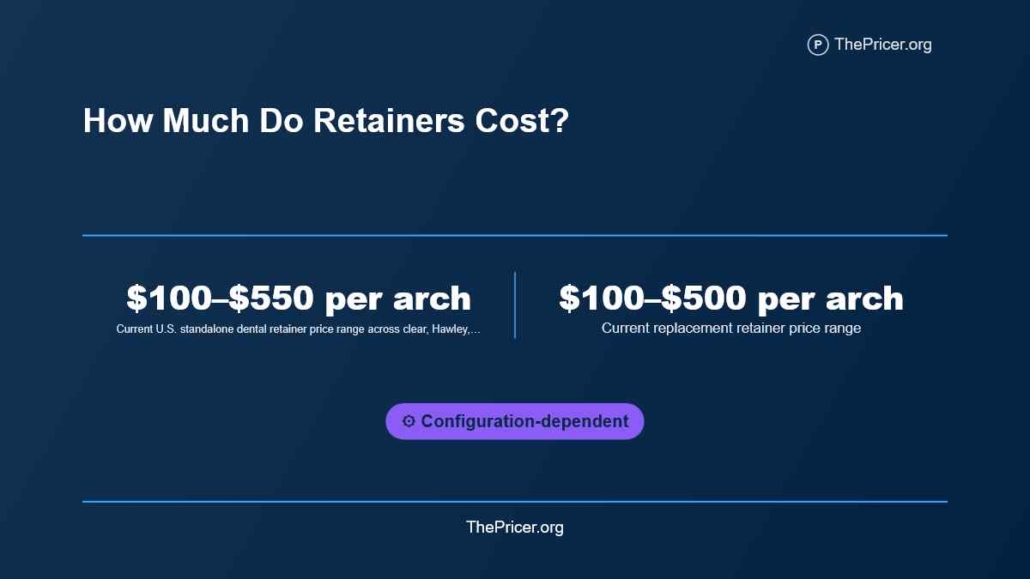
Dental retainers cost about $100 to $550 per arch when purchased separately in the United States, depending on whether the appliance is clear plastic, Hawley-style, fixed, or a branded system. Clear retainers sit near the lower end of that range, while fixed retainers can reach the upper end. If both upper and lower arches need separate appliances, the bill can be roughly twice the one-arch price.
The first retainers may cost $0 separately because the initial set is often bundled into the orthodontic treatment fee. Replacement retainers are different. A lost, cracked, warped, or poorly fitting retainer can create a new out-of-pocket charge, and the long retention period means replacement risk matters almost as much as the first purchase price.
Article Highlights
Jump to sections
- Clear removable retainers run about $100 to $300 (at $30 per hour, earning that amount would take about 0.4 to 1.3 full-time workdays, before taxes) per arch in current published pricing.
- Hawley retainers run about $150 to $340 per arch.
- Fixed retainers can cost about $225 to $550 per arch.
- Replacement retainers often run about $100 to $500 per arch, depending on type and required records.
- The first set is often bundled into braces or aligner treatment, while later replacements may be billed separately.
- Long-term retention is commonly necessary, so replacement frequency can change lifetime spending by hundreds or thousands of dollars.
How Much Do Retainers Cost?
The cleanest way to compare retainers is by arch. Invisalign’s current retainer type pricing lists Hawley retainers at $150 to $340 (about 0.6 to 1.4 full-time workdays at $30 per hour) per arch, Essix retainers at $100 to $300 per arch, and permanent fixed retainers at $225 to $550 per arch. Those are planning ranges rather than office quotes.
| Retainer type | Current price per arch | Calculated two-arch range |
|---|---|---|
| Clear Essix-style | $100 to $300 | $200 to $600 |
| Hawley | $150 to $340 | $300 to $680 |
| Fixed or bonded | $225 to $550 | $450 to $1,100 |
The two-arch figures are simple calculations using the published per-arch ranges. They are not a recommendation to use the same retainer type on both arches. An orthodontist may prescribe different retention methods for the upper and lower teeth. That unit matters. An old article that quotes $150 to $350 per set for a Hawley retainer can understate the bill if the source figure actually applies to one arch.
The table is a planning tool, not a national fee schedule. Orthodontic offices set their own prices, and a quote can change with records, laboratory work, brand, number of arches, and whether the appliance is being made after new tooth movement. A written quote should state the number of arches and appliances covered by the fee.
First Set vs Replacement
The first retainer and a replacement retainer can have very different out-of-pocket prices. Diamond Braces currently lists two removable retainers inside certain orthodontic treatment packages while also posting an Essix retainer at $250 and a fixed retainer at $350 (about 1.5 full-time workdays at $30 per hour) as separate items. Someone finishing braces treatment may receive the first appliances through the treatment package, then face a standalone price later.
Replacement pricing starts a new transaction. Orthodontic Experts’ July 2026 guidance puts a replacement retainer estimate at roughly $100 to $500 per arch. Type, one versus two arches, required records, branded systems, and tooth movement can change the quote. If only the upper removable retainer is lost and the lower still fits, replacing one arch may be enough after the orthodontist checks the case.
This is why “replacement costs the same as the first set” can be misleading. A first set that was bundled into a $4,000+ orthodontic treatment does not have a visible standalone price to match. The paid replacement might be $100, $250, $500, or another office-specific amount. The useful comparison is the treatment package inclusion against the later replacement quote. That difference matters.
Clear, Hawley, Fixed, and Vivera
Clear retainers are removable plastic trays molded to the teeth. Hawley retainers are removable appliances that combine acrylic or hard plastic with wire. Fixed retainers use a thin wire bonded behind selected teeth. The right choice depends on the orthodontic plan, cleaning needs, wear habits, bite, and how the teeth were moved. Price alone does not decide which design fits a case.
Clear retainers have a low entry price in many current ranges and are easy to replace as a single arch. Hawley appliances cost more in many published examples but use a different construction. Fixed retainers remove the problem of forgetting nightly wear for the teeth they cover, yet a loose bond or damaged wire can create a repair bill. They also require careful cleaning around the bonded wire.
Vivera is a branded clear-retainer system from Align Technology. The provider materials state that an initial order includes four sets of retainers, giving the patient backups if one is lost or damaged. Pricing is provider-dependent. That makes the package quantity part of the comparison. A higher checkout total can still represent a lower cost per supplied set than buying one replacement at a time.
Patients comparing post-treatment options after Invisalign treatment should ask how many retainers are included, whether the office keeps the digital scan, and what a later reorder costs. Those details can matter more over time than a small difference in the initial quote.
The Hidden Cost Is Replacement
Loss and breakage are only part of the replacement problem. A bonded wire can detach from one tooth, a clear tray can warp from heat, and an appliance can stop seating correctly after tooth movement. Current 2026 specialist guidance puts bonded-retainer repair estimates around $100 to $250 for a minor single-tooth rebond and roughly $200 to $600 per arch for broader repair or replacement work.
Protection programs show how repeated replacements can change the math. Diamond Braces currently offers eligible former patients a lifetime replacement program for $800. During the first two years, the program allows up to four Essix retainers per year. After that period, replacements cost $75 each. Fixed retainers are excluded.
Using Diamond’s separately posted $250 Essix price from the earlier pricing example, four standalone replacements would cost $1,000. The $800 program would be $200 less if an eligible patient actually needed four replacements during the first two years. Three replacements would total $750 at the posted standalone rate, so the protection plan would not yet be cheaper. The break-even point sits between the third and fourth replacement under those current rates.
This is a spending threshold, not a prediction that anyone will lose four retainers. The useful lesson is that replacement plans only save money when actual replacement use is high enough to overcome the upfront fee.
Insurance, FSA, and HSA Payment

Dental insurance treatment varies by plan and by whether the retainer is part of the original orthodontic case or a later replacement. The AAO says replacement retainers are often self-pay after the original orthodontic package, while many plans allow FSA or HSA funds to help with the expense. The orthodontic office can check benefits, but the insurer and account rules control the final coverage decision.
That distinction matters for budgeting. A treatment contract may already include the first removable retainers, so insurance does not necessarily create a separate retainer payment at the end of treatment. Years later, the same patient may face the full office price for a lost upper retainer because replacement coverage has ended or was never included.
FSA and HSA access can reduce the cash burden, but eligibility should be checked before payment. A card being accepted by the orthodontic office does not by itself settle whether an expense qualifies under a particular account. Keep the receipt and written treatment description if the plan administrator requires documentation.
Before paying, ask for four numbers in writing. Get the one-arch price, the two-arch price if both are needed, the replacement price, and any scan or records fee. That makes insurance and account reimbursement much easier to evaluate against the cash bill.
Retainer Lifespan
Retainer ownership is a long-term cost because retention does not simply end after two years. The AAO says retainer wear is typically lifelong, although the frequency may decrease as directed by the orthodontist. The same guidance says a well-cared-for retainer can last many years but will likely need replacement at some point.
Long wear turns replacement frequency into a major cost variable. Take the current $250 Diamond Essix price as a fixed input and choose two illustrative schedules for one arch. Replacing it every two years across a ten-year period means five purchases and a modeled spend of $1,250. Replacing it only twice during the same ten years means $500. The difference is $750, even though the retainer’s sticker price never changed.
Those intervals are assumptions for the calculation, not promised product lifespans. Real replacement timing depends on fit, wear, damage, material, grinding, cleaning, storage, and changes in the teeth. A person who keeps a removable retainer safely for years can spend far less than someone who repeatedly loses or damages the same type.
The cost comparison also changes when a package supplies backups. Four retainers stored safely can reduce the urgency and office cost of an unexpected loss. A single-retainer quote may look cheaper today while creating more future transactions.
When a Retainer Stops Fitting
A replacement bill can become much larger if tooth movement has already occurred. AAO guidance says a retainer that does not fit or causes pain should not be forced. An orthodontist may determine that a new retainer is enough, or that clear aligners may be needed to move one or more teeth back before a new retainer is made.
That creates the article’s largest hidden financial risk. A prompt $100 to $500 replacement can be far cheaper than another course of tooth movement if the teeth drift enough that the old appliance cannot seat. The exact retreatment price depends on the new orthodontic problem and cannot be inferred from the retainer price alone.
Readers who need new alignment rather than simple retention are looking at a different service. Current ceramic braces costs and shorter cosmetic systems such as Six Month Smiles pricing involve active tooth movement, not replacement of a passive appliance. They should not be mixed into a retainer price range.
Speed matters after loss or damage. The right next step is to contact the orthodontic office before assuming an old tray can still be used or ordering a replacement from old records. A current fit check protects against paying for an appliance that matches a tooth position that no longer exists.
Choosing the Best Value
Compare one arch with one arch. Check how many appliances the quote supplies, whether new digital records are needed, and whether repair is possible before paying for a full replacement. For a bonded retainer, ask how the office prices a single loose bond versus a complete new wire.
Removable and fixed retainers solve the same broad retention problem in different ways. A removable appliance can be lost but is easier to take out for cleaning. A fixed wire cannot be misplaced in a restaurant napkin, yet the wire or bonding points can fail. Vivera adds backup quantity to the decision. Hawley adds a different material and wire design. The right economic comparison is the price of the orthodontist’s suitable options plus the likely replacement pathway, not a universal claim that one type is cheapest.
Makes sense if
- The quote states the price per arch and the number of retainers supplied.
- Your first retainers are already included in the orthodontic treatment fee.
- A multi-set package gives useful backups at a price you can justify.
- You can use insurance, FSA, or HSA funds under your plan rules.
Does not make sense if
- You are buying both arches when only one appliance needs replacement.
- A protection plan costs more than your realistic replacement use is likely to justify.
- The retainer no longer fits and you are trying to solve tooth movement with an unverified replacement order.
- You are choosing a fixed or removable design only because its sticker price is lower.
Answers to Common Questions
How much does one clear retainer cost?
A current planning range is about $100 to $300 per arch. A two-arch purchase can reach roughly $200 to $600 if both appliances are priced at the same per-arch rate.
How much does a Hawley retainer cost?
Current published pricing puts Hawley retainers around $150 to $340 per arch. Two arches would calculate to about $300 to $680 if the same pricing structure applies to both.
How much does a replacement retainer cost?
Replacement retainers often run about $100 to $500 per arch. The type of appliance, number of arches, records needed, and whether the teeth have shifted can change the quote.
Does dental insurance cover replacement retainers?
Coverage varies. The first retainers may be part of the original orthodontic benefit, while later replacements are often paid out of pocket. Check the specific dental plan before assuming a replacement is covered.
Do you have to wear retainers forever?
Long-term wear is commonly necessary after orthodontic treatment, often for life with frequency adjusted by the orthodontist. The exact wear schedule should come from the clinician managing the case.
Disclosure: Educational content, not medical advice. Pricing varies by provider, location, and insurance. Confirm eligibility, coverage, and out-of-pocket costs with a licensed clinician and your insurer. See our methodology and corrections policy.