
How Much do Roller Skates Cost?
Updated on | Written by Alec Pow
This article was researched using 10 sources. See our methodology and corrections policy.
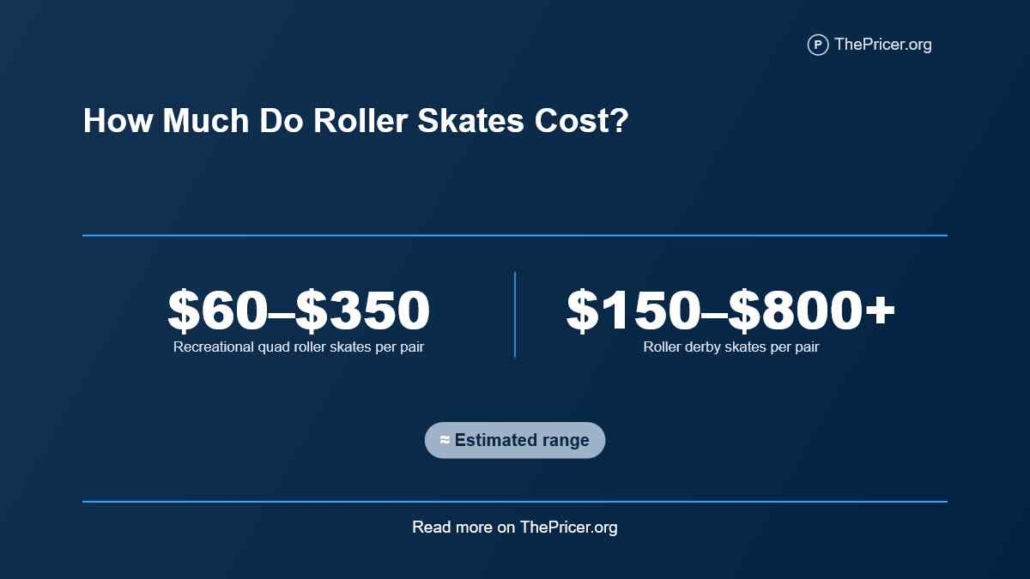
Roller skates generally cost $60 to $350 per pair for recreational use in the United States, while specialized roller derby, artistic, and custom setups can cost $400 to more than $1,000. Entry-level adult quad skates from established recreational brands commonly fall around $100 to $200. The final cost depends on boot construction, plates, wheels, and whether the buyer needs protective equipment.
These prices refer primarily to quad roller skates, which have two wheels at the front and two at the back. Inline skates use a different wheel arrangement and are priced separately. A new skater also needs to consider fit, wheel suitability, and replacement parts, since a low-priced pair may become more expensive after its first upgrades.
Article Highlights
Jump to sections
- Entry-level recreational quad skates generally cost $60 to $150 (at $30 per hour, earning that amount would take about 2 to 5 hours of work, before taxes) per pair.
- Impala lists basic adult quad models around $107 to $119.
- Sure-Grip lists its Boardwalk Plus at $259.99 and Fame at $199.99.
- Roller derby setups range from affordable complete packages to custom boots and components costing substantially more.
- A certified helmet and complete knee, elbow, and wrist pad set can add approximately $157.
- Replacement outdoor quad wheels can cost $36 to $90, depending on the package and included bearings.
How Much Do Roller Skates Cost?
Recreational skating, roller derby, artistic skating, and park skating place different demands on boots and components. The cheapest appropriate pair depends on what the skater intends to do.
| Type of roller skate | Indicative price per pair | Typical use |
|---|---|---|
| Budget recreational quad | $60–$120 (about 2 to 4 hours of work at $30 per hour) | Occasional skating and beginners |
| Midrange recreational quad | $120–$300 | Regular indoor or outdoor skating |
| Premium recreational quad | $300–$500+ | Frequent skating and component upgrades |
| Roller derby quad | $150–$800+ | League practice and competition |
| Artistic or specialty quad | $200–$1,000+ | Dance, figures, artistic performance |
| Adult recreational inline | $100–$350+ | Fitness, commuting, urban skating |
These are shopping ranges, not representative national averages. Professional setups can exceed the upper values, while clearance offers can fall below the lower values.
Impala currently advertises adult recreational quad skates at $107 for its Black model and $119 for Black Leopard. Its Lightspeed inline model is listed at $167. These are different designs intended for different styles of skating.
Sure-Grip’s published quad skate selection includes the Fame at $199.99 and Boardwalk Plus at $259.99. This gives buyers concrete midrange comparisons rather than relying entirely on broad category estimates.
Boot height, stiffness, padding, plate geometry, and wheel configuration matter more than a simple beginner-versus-professional label. An expensive derby skate may be unsuitable for someone who primarily wants a comfortable high-top recreational skate.
What Beginner Roller Skates Cost
A beginner does not necessarily need leather boots, aluminum plates, or premium bearings. A correctly fitted complete pair with dependable wheels and functional braking hardware is the priority.
Lower-cost adult quad skates often use synthetic uppers and relatively simple plates. Some have bolt-on toe stops, while more adjustable models use replaceable threaded stops. A skate’s design determines which replacement parts will fit.
A 2026 beginner skate comparison identifies models from Impala and Chicago among affordable options and discusses supportive boots, fit, and skating surfaces as important selection criteria.
A budget of around $100 to $150 (about 3.3 to 5 hours of work at $30 per hour) is a practical starting point for comparing new adult recreational quad skates from recognizable brands. Buyers planning frequent skating may find the wider $150 to $300 range useful because it opens up different constructions and component choices.
Children’s skates require a separate fit assessment. Adjustable sizing can extend the period before replacement, but a skate that is too loose today should not be purchased merely to accommodate future growth.
How Much Are Roller Derby Skates?
Roller derby commonly uses lower-cut quad boots that permit ankle movement during lateral skating, turning, and rapid direction changes. Complete entry-level packages are different from custom setups sold as separate boots, plates, wheels, and bearings.
Bont lists Prostar roller derby boots at $169 and certain customized Prostar boot variants at $315. These are boot prices, not necessarily complete ready-to-skate packages.
This distinction matters when comparing derby equipment. An advertised $169 boot can require additional spending before it becomes a usable pair of skates. A complete recreational or derby package already includes essential rolling components.
Derby skaters also need appropriately fitted protective gear, and local league requirements may be more demanding than casual rink use. Before choosing equipment, ask the league about acceptable helmets, mouthguards, pads, and wheel configurations.
Competition-level purchases become expensive when multiple parts are selected independently. A boot, two plates, eight wheels, sixteen bearings, hardware, and professional mounting may all contribute to the final bill.
Quad Skates vs Rollerblades
Inline skates have wheels arranged in a single row. Their boots, frames, and braking systems differ from traditional quad roller skates, so the cheapest option in one category may not serve the same purpose as the cheapest in the other.
Rollerblade’s current US inline collection lists the Zetrablade at $149.99, Macroblade 80 at $179.99, and Twister XT at $349.99. Premium long-distance and specialized equipment costs more.
That places many recreational inline models in a similar spending bracket to midrange quad skates. The skating surface, preferred activity, fit, and braking technique should decide the format rather than a small price difference.
A separate rollerblade pricing comparison covers inline-specific purchases in more detail. Quad models remain the central subject here.
Why Some Roller Skates Cost More
The boot accounts for a substantial part of the difference between a basic recreational pair and a more expensive model. Leather and suede constructions may offer different break-in and fit characteristics from vinyl or molded synthetic materials. Price alone does not establish which boot will be more comfortable.
The plate connects the boot to the trucks and wheels. Nylon plates can be appropriate on recreational and derby equipment, while aluminum plates offer different stiffness, weight, and durability characteristics. A metal plate is not automatically a better choice for every skater.
Wheel hardness is another important distinction. Softer wheels generally offer more grip and help absorb irregularities on rough outdoor surfaces. Harder wheels can be useful on smooth indoor floors where skaters want different rolling and sliding behavior.
Bearing ratings deserve caution. ABEC numbers describe manufacturing tolerance under a particular rating system, not the entire quality or speed of a skate bearing. Cleanliness, lubrication, construction, loading, and condition matter. Replacing functional bearings solely to obtain a higher ABEC number may offer little practical benefit.
Finally, specialized boots and properly matched hardware can cost more because of their construction and intended performance. Those features deserve consideration when they solve a real fit or skating problem.
Wheels and Protection
The first purchase is not always the final expense. Protective equipment, wheel changes, and worn braking components can make the all-in cost substantially higher than the advertised price of the skates.
Triple 8 lists its Certified Sweatsaver skate helmet at $59.99. The product carries both CPSC bicycle-helmet and ASTM F1492 skate-helmet certifications, as described in the manufacturer’s listing.
187 Killer Pads advertises a six-piece adult protective set for $96.99. It includes protection for the knees, elbows, and wrists.
Together, those two products cost $156.98 before tax. This is enough to change the purchasing decision for someone comparing a very cheap pair of skates with a more expensive complete starter budget.
Wheel replacement creates another meaningful cost difference. Roller Skate Nation lists a Rincon wheel-and-bearing package containing eight 85A wheels and bearings for $35.99.
A different outdoor wheel conversion package costs $89.99. It includes eight 78A wheels, sixteen bearings, lubricant, and tools.
The second package costs $54 more, but contains additional tools and uses softer wheels. The packages should not be judged as identical products solely because both contain eight wheels.
What a Complete Beginner Setup Costs
A realistic starting budget combines skates with protection. Consider a new adult skater purchasing a pair of Impala Black quad skates and the specific helmet and pad package described above.
- Impala Black quad skates: $107.00
- Triple 8 Certified Sweatsaver helmet: $59.99
- 187 Killer Pads six-piece set: $96.99
- Additional wheels: $0, using the supplied wheels initially
The calculated equipment total is $263.98 before tax, delivery, or optional accessories. It is an illustrative purchase assembled from separate advertised offers, not a retailer’s bundle.
The safety equipment accounts for approximately 59% of this total. Someone budgeting only the $107 skate price would underestimate the illustrated startup purchase by nearly $157.
There is a second useful comparison. If the owner later buys the $89.99 outdoor conversion kit, cumulative equipment spending rises to $353.97. Choosing the less expensive $35.99 wheel-and-bearing set instead would produce a total of $299.97. Those totals exclude any rink admission fees and protective items not in the chosen set.
Such upgrades are optional, not mandatory annual charges. Skaters who find the factory wheels suitable may not need to replace them for a considerable period.
Buying Used and Maintaining Skates

Used roller skates can be attractive when their boots fit correctly and the components are in good condition. Inspect both boots for separation around the soles and heels, damaged eyelets, cracked plates, bent trucks, and worn wheel hardware.
For a used-pair comparison, assume the seller asks $80 and the buyer immediately requires the $35.99 wheel-and-bearing package discussed earlier. The combined expense becomes $115.99, before shipping or other work.
That amount exceeds the current advertised $107 price of the entry-level Impala Black model. The used pair might still have better construction, but the apparent purchase-price discount has disappeared. This is why condition and replacement-part compatibility matter more than the percentage discount alone.
Routine maintenance includes removing debris, inspecting wheel wear, checking axle nuts and toe stops, and cleaning serviceable bearings according to their manufacturer’s instructions. Hardware must be tightened correctly without restricting wheel movement.
Do not assume wheels must be rotated after a fixed number of sessions. Wear depends on skating frequency, pavement, weight distribution, and wheel configuration. Uneven wear, flat spots, and reduced grip provide more useful inspection signals.
Before buying online, review the size chart and return terms. Roller Skate Nation’s published product return conditions illustrate that returns and exchanges can have different time limits and shipping costs, and visibly used items may face restrictions.
Which Roller Skates Should You Buy?
The right purchase begins with skating conditions. A casual indoor skater, an outdoor recreational skater, and a derby participant may each require different boots and wheels despite having similar budgets.
Makes sense if
- Buying entry-level complete quads for occasional recreational use.
- Spending more on a comfortable, well-fitting boot for frequent sessions.
- Choosing softer compatible wheels for rough outdoor skating.
- Purchasing used higher-quality skates after inspecting the complete setup.
Does not make sense if
- Buying expensive derby components for occasional rink sessions.
- Choosing skates that are too large in anticipation of future growth.
- Paying extra for a bearing rating without identifying a performance problem.
- Buying replacement wheels without checking their diameter, axle compatibility, and intended surface.
Skating also overlaps with the equipment needs of skateboarding. Helmets and some protective pads may be suitable for both when their specifications, certification, fit, and intended use match.
Answers to Common Questions
How much should beginners spend on roller skates?
A new adult skater can compare complete recreational quad pairs around $100 to $150. Protective equipment should be included in the total budget rather than treated as part of the skate package.
Are expensive roller skates worth buying?
Higher-priced models may justify their cost through fit, construction, replaceable components, and suitability for demanding skating. Casual users may not benefit from every premium feature.
Can you use indoor roller skates outside?
Many quad skates can be used on suitable outdoor surfaces, but wheel choice matters. Softer outdoor-compatible wheels generally improve comfort and grip on rough pavement. Check the manufacturer’s specifications and skating conditions.
How often do roller skate wheels need replacing?
There is no universal replacement schedule. Replace wheels when wear, damage, flat spots, or deterioration affect their safe and predictable performance. Frequency depends on skating surface and use.
Are roller skates cheaper than rollerblades?
They can be, but recreational quad and inline skate prices overlap significantly. Comparable quality, intended use, equipment included, and fit matter more than which arrangement has the lowest advertised starting price.
Disclosure: Educational content, not financial advice. Prices reflect public information as of the dates cited and can change. Confirm current rates, fees, taxes, and terms with official sources before purchasing. See our methodology and corrections policy.