
Ford F-150 Tune-Up Cost
Last Updated on September 14, 2023
Written by CPA Alec Pow | Content Reviewed by  CFA Alexander Popinker
From time to time, you need to make sure your truck receives a tune-up if you want to keep it in its best possible shape. Depending on who is doing the job, the cost of a tune-up can be very low or very high.
Expect to pay around $450 for an average Ford F-150 tune-up at a Ford dealership, while the costs at a third-party shop would be anywhere between $280 and $350.
Though, you may be able to save a lot of money if you have the right experience and tools for doing the vehicle’s maintenance yourself. This is because the cost of the parts represents 25% to 40% of the total cost, while the rest is represented by the labor costs.
How much does a tune-up cost at Ford?
Be prepared to spend a minimum of $450 at a licensed Ford dealership for a Ford F-150 tune-up. A transmission fluid change, the plugs, the throttle body clean, the filters, the IAC clean, and the coolant flush will be included in this cost.
The prices charged by a Ford dealership are a little higher, but compared to a third-party tune-up it will include more car systems checked and replaced if needed.
What does a tune-up include?
It all depends on your preferences and the level of tune-up you wish. For instance, the engine is made of hundreds of pieces and around forty of these are moving pieces that need constant maintenance.
However, there are a few important components that need to be replaced regularly and are considered to be part of a tune-up. These are:
The Fuel filter is one of the most important components of the car’s fuel supply system. This component is very important given the fact that it does not allow dirt, dust, rust, contaminants, or other substances to get inside the car’s engine.
You might also like our articles on the cost of a tune-up for a car, a tune-up for a bike, and a car reupholster.
In order to prevent serious problems with the car’s engine, it is recommended that drivers periodically change their fuel filters, and this operation is so simple that it can be carried out in your own garage, without the need for a visit to the car shop.
Air filter
The air filter is extremely important for any engine. It provides the engine with perfectly clean air, without impurities that could reach the combustion chamber.
No internal combustion engine can work without air. An engine without an air filter can work, but only for a very short time.
PCV valve
Probably, through time, you have heard people talking about the PCV valve of a gasoline or gas engine, but there is a possibility that you have not heard how important this small component is in terms of the engine.
As a rule, PCV valve problems are for drivers who own cars with gasoline engines, and the valves are made of plastic hoses that have an internal spring. It is natural for these valves to fail after a certain time, because any plastic material that is mounted in a place with high temperatures, fails after a certain time.
Spark plugs
Spark plugs are components of the car engine that have the role of igniting the fuel (whether it is gasoline or diesel) from the combustion chambers of the engine. The spark plugs have a cylindrical shape, and the burning power is given by their size. These components are positioned the other way around, that is, their “head” is down, in order to reach the combustion chamber.
Wires
Spark plug wires are a component found in many internal combustion engines. They usually consist of a conductive core surrounded by several insulating layers, as they are designed to withstand very high voltages. In traditional ignition systems, spark plug wires connect the ignition coil to the distributor and the distributor to the spark plugs.
In short, the fuel injector is an electronically controlled valve that sends fuel to the combustion chamber in the form of a very fine powder. The fuel injector receives fuel from the high-pressure rail and has the ability to open and close several times per second. All its actions are electronically controlled by the ECU (Electronic Control Unit).
Sings that your vehicle needs a tune-up
Some of the most common signs that your car needs a tune-up are:
- Poor fuel economy
- The vehicle is harder to start than it used to be
- Rough idle or/and engine knocking
- Engine stalling
How much does a coil pack for a Ford F-150 cost?
Expect to pay anywhere between $950 and $1,400 to replace the ignition coils in a Ford F-150 at a dealership. A large share of the cost is represented by labor, so you should get a kit and do this job yourself.
Keep in mind that this price range does not include disposal fees and taxes.
How Do You Change A Coil Pack On A Ford F-150?
There are a few steps you need to follow in order to change a coil pack on a Ford F-150:
- locate and remove the fuel rails;
- remove the associated electrical bolts and connectors;
- twist the coil counter-clockwise in order to remove it from its plug;
- replace the broken coil pack;
- twist the coil clockwise in order to tighten it to its plugs;
- reinstall the fuel rails.
How often should I get a tune-up?
You will need to get a tune-up pretty frequently if you have a late-model vehicle. Actually, if you have an old car that uses a non-computerized ignition system, you will have to tune it up once per year or every 10,000 to 12,000 miles.
On the other hand, for the more modern vehicles, with an electronic computerized ignition system, the tune-up up can be done every 25,000 or even 100,000 miles.
How often should I change spark plugs in a Ford F-150?
Spark plugs are the most important components of a tune-up. These are compatible with a wide range of Ford vehicles and model years that use the 4.6L V8 engine.
It is recommended to change the spark plugs every 100,000 miles. Also, when you do this, you should replace the engine coolant.
What brand of spark plugs does Ford use?
The old Ford engines are equipped with low-quality Motorcraft plugs, while the modern vehicles are equipped with factory-installed, high-quality Bosch spark plugs.
What are the signs that will tell you that the spark plugs need to be changed?
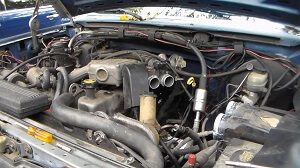 The spark plugs show advanced wear when the engine emits noises, the fuel consumption is increased, it has low power, or when it misfires. The visual state of the spark plugs conveys signs of engine problems or lack thereof.
During normal operation of the engine, the spark plug shows no signs of wear, its color is grey-brown, which is caused by deposits from the combustion process.
Conversely, if there are deposits of oil on the spark plug, this is not good. Deposits appear for several reasons: oil enters the combustion chamber, excessive wear of the piston segments, the cylinder liner, the lubrication valve, or an oil level that is too high.
How long do Ford ignition coils last?
According to the United States Federal law, ignition coils and the associated ignition module which is equipped on new vehicles must be warranted for a minimum of 24,000 miles or two years.
Keep in mind that the insulation in ignition coils breaks over time, so there is a particular rating for every model. However, most should last a minimum of 100,000 miles.
What is a tune-up kit?
With a tune-up kit, you will be able to replace many engine parts in one job. This is an all-in-one package that includes pieces such as oil filters, spark plugs, fuel filters, plug wires, air filters, and a distributor cap (for older models).
These kits are very useful because they include everything you need to perform a tune-up on your own. You will save a lot of money with a kit such as the ENA Brand Set of 8 Ignition Coils. This kit is compatible with the 1996 – 1999 model years 4.6L F-150 and is a functional replacement for part number FD487.
Better Than OEM Quality
These kits are designed to be better than the OEM quality standards, which means that each process and part used to make these components improves or matches the original Ford design specification.
This provides great reliability and performance and ensures an easy and fast installation.
With such a low cost tune-up kit you will be able to solve many popular ignition coil problems such as hard start and even no start, a check engine light, long crank time, poor fuel economy, misfires, premature catalytic converter failure, lack of power, spark plug fouling and inconsistent transmission shifts.
Is a full tune-up always necessary?
No, you don’t need to fully tune up your vehicle. The most important part is replacing the coils and plugs in a coil-driven system and replacing the wires and plugs in a distributor cap-driven system.
What does a tune-up improve?
One of the main benefits of a tune-up is the significant improvement of your car’s fuel economy. A new set of plugs will make your vehicle’s engine start much easier.
Also, the gas emission will be lowered and any gradual power losses will be removed.
Is a tune-up worth it?
The answer is definitely yes because this is one of the most important parts of regular car maintenance. You will find out that a tune-up is classified as a main service, if you take a look in the service manual of your car.

Leave a Reply
Want to join the discussion?Feel free to contribute!