
How Much Does it Cost to Paint a Fender?
Updated on | Written by Alec Pow
This article was researched using 14 sources. See our methodology and corrections policy.
Painting one car fender professionally usually costs about $300 to $900 when the panel is repairable and the job includes normal preparation, color matching, basecoat, and clear coat. A simple repaint can start near $200 at some shops, while dent repair, rust, difficult pearl or metallic colors, or blending into the hood or door can push a premium repaint above $1,000. Replacing a damaged fender creates a different bill because the shop must buy, fit, prepare, paint, and install the panel.
The fender condition decides whether the estimate covers paint alone, body repair plus paint, or replacement plus paint. Compare those scopes separately.
Article Highlights
Jump to sections
- A straightforward professional fender repaint commonly falls around $300 to $900 (at $30 per hour, earning that amount would take about 1.3 to 3.8 full-time workdays, before taxes).
- One California shop currently advertises fender painting from $200, with the final quote based on panel condition.
- Current 2026 Nevada shop surveys show refinish labor rates from $60 to $150 per hour in the examples reviewed.
- A replacement fender can cost less than the paint and labor required to finish and fit it.
- Blending an adjacent door or hood can raise the estimate even when those panels are not damaged.
- DIY paint materials can start below $100, but proper preparation, safety gear, and paint-matching difficulty matter.
How Much Does It Cost to Paint a Fender?
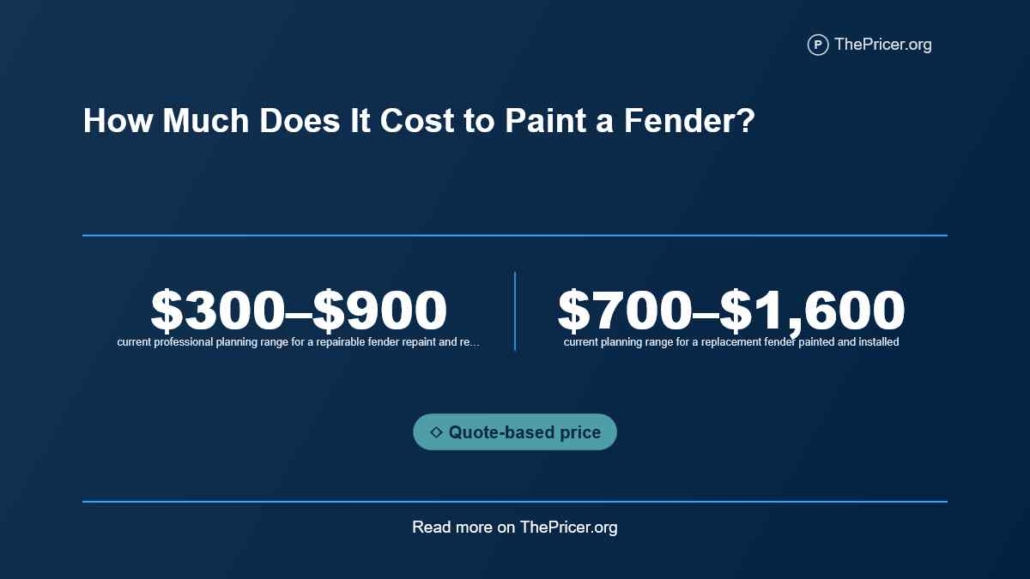
A useful current planning range is $300 to $900 (about 1.3 to 3.8 full-time workdays at $30 per hour) for a professional fender repair and refinish. A 2026 Southern California collision guide places fender repair and refinish in that band when the panel remains repairable and puts replacement around $700 to $1,600. A separate body-shop guide updated in 2025 puts ordinary fender repaint work around $300 to $700, with higher totals when preparation, repair, or premium paint increases the scope.
The low end can be lower for a clean panel. One current California booking page advertises fender painting from $200, with the final price tied to whether the fender is new, used, or needs repair. That starting price should not be treated as a national average or as a quote for damaged paint.
| Fender job | Planning price | What changes the bill |
|---|---|---|
| Clean-panel repaint | $200 to $500+ | Prep needed, paint system, color match, shop rate |
| Repairable fender plus refinish | $300 to $900 | Dent depth, scratches, filler, primer, paint |
| Premium color or adjacent-panel blending | $700 to $1,000+ | Pearl or metallic color, tinting, door or hood blend |
| Replacement fender, painted and installed | $700 to $1,600 | Part source, fit, paint, installation, blending |
These are planning bands, not a flat national menu. The quote should state whether body repair, removal and installation, paint materials, blending, clips, corrosion protection, polishing, and tax are included. A quote that covers only spraying an already-prepared fender is not comparable with one that starts with collision damage.
What a Fender Repaint Includes
A front fender is the exterior body panel around the wheel opening between the bumper area and the front door. On many cars it is a bolt-on steel or aluminum panel. A rear quarter panel may look similar around the wheel opening, but it is often part of the welded body structure and is priced differently. That distinction matters when a shop talks about repairing a “fender.”
A professional repaint begins before color is sprayed. The shop cleans and inspects the panel, removes or protects trim, sands the existing finish, repairs small surface defects, applies primer where needed, checks the color formula, sprays basecoat, applies clear coat, cures the coating, and performs finish work. A damaged panel may need straightening, filler, feathering, blocking, or corrosion treatment before it reaches paint-ready condition.
The paint code is only the starting point for a match. Age, sunlight, prior repairs, factory color variants, metallic orientation, and paint-system differences can make a formula look slightly different beside the original finish. That is why two quotes for “paint one fender” can describe different amounts of work.
The same distinction appears in car hood painting costs. A sound panel needing color and clear coat is a different job from a panel with failed clear coat, dents, rust, or previous repair material underneath.
Dents and Surface Repair
Painting cannot correct a distorted panel by itself. A shallow dent with intact paint may qualify for paintless dent repair, which can avoid refinishing altogether. Once the paint is cracked, deeply scratched, chipped to bare metal, or the metal needs filler and reshaping, the estimate changes into body repair plus refinish. The 2026 collision guide cited above places small paintless dent work around $125 to $300 (about 0.5 to 1.3 full-time workdays at $30 per hour) per dent and repairable fender work with refinishing at $300 to $900.
Deep scratches also need to be classified correctly. A mark limited to clear coat may respond to polishing or correction rather than repainting. The distinction is covered in paint correction pricing. A scratch through the color coat or into primer and metal is a different repair because new coating layers must be rebuilt.
Rust is another boundary. Surface oxidation can sometimes be removed and refinished, while perforation or weakened metal can turn the job into panel repair or replacement. Painting over active corrosion does not restore the metal beneath it.
A shop should identify the repair area before quoting paint. Ask how many body-labor hours, refinish hours, and paint-material units are on the estimate. That reveals whether a higher bill comes from the paint work or from restoring the fender to a paintable shape.
Replacement Fender Economics
A severely creased bolt-on front fender may be cheaper to replace than to spend many hours straightening it. Current parts pricing shows why the panel itself is only one part of the total. A recent Hyundai Sonata replacement guide lists standard aftermarket fenders at $97.95 to $113.95, installation labor at $100 to $200, and painting at $300 to $700. Its OEM part estimate is $220 to $425.
Using those published inputs, an aftermarket replacement scenario comes to about $497.95 to $1,013.95 before tax or any extra blending. The calculation is $97.95 to $113.95 for the panel, plus $100 to $200 installation, plus $300 to $700 paint. Using the cited OEM part range instead produces about $620 to $1,325 under the same labor and paint assumptions.
That calculation explains why “the fender only costs a hundred dollars” can be misleading. The inexpensive part still arrives needing preparation, alignment, color, clear coat, and installation. Fit problems can create more labor, and clips or adjacent damaged parts can add to the estimate.
Replacement is not automatically cheaper. If the existing fender needs only limited straightening and the original panel fits correctly, repair can avoid part sourcing and alignment work. The estimator should compare total repair hours with the full replacement scope.
Color Matching and Blending
 Modern collision painting often extends color beyond the repaired fender so the eye does not see a hard color change at the panel edge. I-CAR explains that blending and tinting are used when factory color variants, weathering, prior repairs, and pigment differences make an edge-to-edge match difficult. Metallic and pearl finishes can make this issue more visible because flake orientation affects the appearance.
This is one reason a fender estimate can include work on an undamaged door or hood. The adjacent panel may be prepared and receive blended basecoat, then clear coat, so the new color changes gradually rather than stopping at the gap. The process adds labor and materials even though the neighboring panel was not hit.
Current 2026 Nevada body-shop surveys also show how shop rates change the same operation. One Las Vegas shop reports a refinish rate of $60 per hour and a paint-material rate of $35 per hour. A Pahrump shop reports $150 per hour for refinish labor and $100 per hour for paint materials.
Those two state-survey examples do not define national rates. They show that the same four assumed refinish hours would represent $240 of refinish labor at one shop and $600 at the other before materials. That 2.5-to-1 spread helps explain why location and shop structure can move a panel quote so much.
DIY Fender Painting
DIY materials can be much cheaper than a professional refinish when the fender is already straight and the owner has a clean work area. PaintScratch currently sells a color-matched aerosol system for larger repairs, with a package containing primer, basecoat, clear coat, and polishing product at $70.92. Sandpaper, masking supplies, cleaners, tack cloths, body filler, tools, and protective equipment can raise that figure.
The aerosol package is not the full DIY budget. A spray gun, compressor, sanding equipment, masking supplies, cleaners, and protective gear can raise the total if they are not already owned. DIY removes shop labor, but it does not remove the preparation or color-matching work.
Spraying automotive coatings also carries health risks. NIOSH identifies solvents, metals, and polyisocyanates in autobody paint overspray and recommends engineered ventilation, proper spray equipment, and protective equipment. A home driveway or enclosed garage is not equivalent to a controlled spray booth.
DIY makes the most financial sense for a removable, low-value panel where a small cosmetic mismatch is acceptable and the painter already owns the needed equipment. A late-model metallic or pearl vehicle that must match adjacent panels is a much harder first paint project.
Insurance and Estimate Charges
Insurance may pay for fender damage when the cause and policy coverage fit the claim. The National Association of Insurance Commissioners explains that collision coverage pays for crash damage to the insured vehicle, while coverage for listed non-collision losses can apply to hail, theft, weather, fire, or animal impact. Both can involve a deductible.
That means a $600 fender repair does not automatically become a sensible insurance claim. If a policy has a $500 deductible and the covered repair is $600, the insurer’s potential payment before any other policy effects is only $100. A $1,500 covered repair under the same deductible leaves $1,000 above the deductible. Those are simple examples, not advice about a particular policy or future premium.
Shop estimates can also contain items that do not look like “paint.” State survey entries show separate charges for masking, hazardous-waste handling, color tinting, sanding and buffing, and featheredge-prime-block work. Those line items may be legitimate parts of the repair scope rather than duplicate paint charges.
Read the estimate by operation. Compare body labor, refinish labor, materials, parts, blending, removal and installation, sublet work, and taxes. That approach is more useful than comparing only the final number from two shops.
Repair or Replace Decision
A repaint-only job works when the panel is structurally sound and the damage is confined to the finish. Repair plus repaint fits dents and scrapes that can be restored without excessive metal work. Replacement becomes more attractive when the fender has severe creases, torn mounting points, extensive corrosion, or repair hours that exceed the cost of a replacement panel and installation.
Do not compare an aftermarket part price with a finished body-shop quote. One is an unpainted component. The other may include fitment, preparation, color matching, paint materials, clear coat, corrosion protection, installation, and blending. The replacement-fender calculation above shows how a part costing around $100 can turn into roughly $500 to $1,015 once paint and labor are added.
Makes sense if
- The estimate separates body repair from refinish work.
- The shop explains whether the hood or door needs blending.
- A replacement quote identifies OEM, aftermarket, or used parts.
- The final price includes the operations needed for a finished panel.
Does not make sense if
- A low paint quote assumes the customer will deliver a fully prepared panel.
- A severely damaged fender is being repaired only to avoid buying a cheaper replacement panel.
- A DIY plan ignores ventilation and coating hazards.
- A vinyl car wrap is being used to hide rust, dents, or failing paint instead of fixing the underlying damage.
A clear scope matters. A higher estimate can still cost less if it already includes blending, finish work, and panel preparation that another quote leaves out.
Answers to Common Questions
How much does it cost to paint one car fender?
A professional fender repaint commonly costs about $300 to $900, with low-end clean-panel work starting near $200 and complex paint or blending reaching $1,000+.
Is it cheaper to repair or replace a fender?
Minor dents and surface damage often favor repair. Severe creases, rust, or many body-labor hours can make a replacement panel cheaper once both options are compared on a painted and installed basis.
Why does a body shop paint the door when only the fender was damaged?
The shop may blend color into the adjacent door so small differences between the new paint and the aged original finish are less visible.
How much can DIY fender paint cost?
A current aerosol primer, basecoat, clear-coat, and polishing package costs about $71 before sandpaper, masking supplies, cleaners, tools, and protective equipment.
Does car insurance cover fender painting?
It can when the damage comes from a covered event and the applicable coverage exists. The deductible still applies, so small cosmetic repairs may leave little for the insurer to pay.
Disclosure: Educational content, not financial advice. Prices reflect public information as of the dates cited and can change. Confirm current rates, fees, taxes, and terms with official sources before purchasing. See our methodology and corrections policy.