
How Much Does a Teddy Bear Dog Cost?
Updated on | Written by Alec Pow
This article was researched using 9 sources. See our methodology and corrections policy.
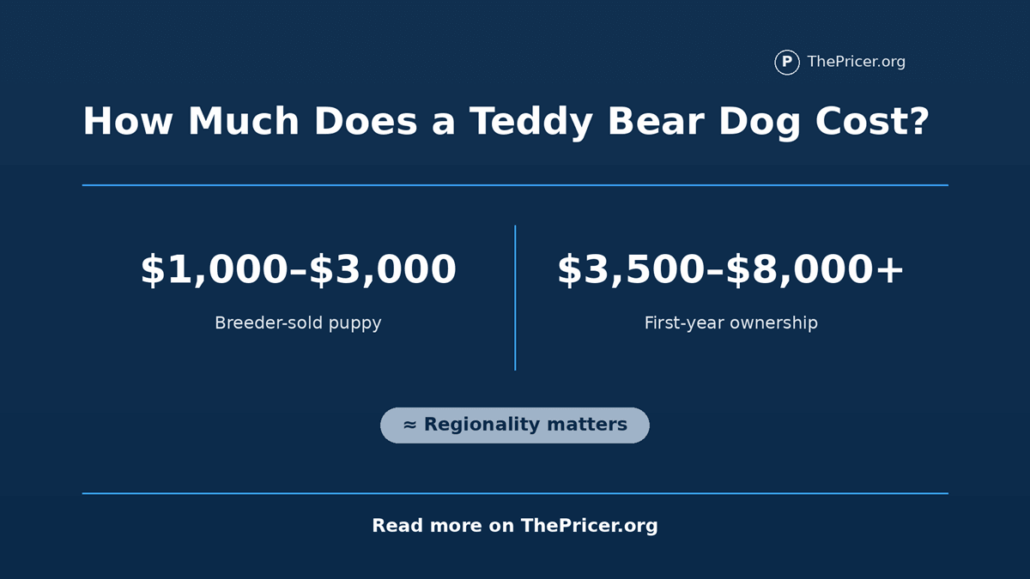
A teddy bear dog typically costs $1,000 to $3,000 from a breeder, although current Shichon puppies commonly fall around $1,500 to $2,500. Puppies promoted as teacup, rare-colored, or premium designer dogs may be listed for $3,500 to $5,000+. Shelter adoption can cost $35 to $500, but the dog may be described as a teddy bear mix based on appearance rather than confirmed parentage.
The purchase price is only the first part of the bill. A small, long-coated puppy can cost another $2,500 to $6,000 during its first year after veterinary care, grooming, supplies, food, training, insurance, and licensing. Recurring care commonly runs $1,800 to $5,000 per year, with emergency treatment, dental work, boarding, dog walking, and chronic conditions added when needed.
“Teddy bear dog” is a sales and appearance label, not one recognized breed. It may refer to a Shichon or Zuchon, which is a Shih Tzu and Bichon Frise cross, or to another small dog with a rounded face and fluffy coat, such as a Maltipoo, Cavapoo, Poochon, Cavachon, or Yorkiepoo.
Article Highlights
Jump to sections
- A breeder-sold teddy bear puppy usually costs $1,000 to $3,000 (at $30 per hour, earning that amount would take about 0.8 to 2.5 full-time workweeks, before taxes).
- Current Shichon listings commonly fall near $1,500 to $2,500.
- Adoption fees may range from $35 to $500, depending on the shelter or rescue.
- First-year ownership commonly costs $3,500 to $8,000+, including the dog.
- Professional grooming can add $400 to $1,200 per year.
- No teddy bear dog or mixed breed is guaranteed to be hypoallergenic.
- Health records for both parent dogs matter more than coat color, tiny size, or designer branding.
How Much Does a Teddy Bear Dog Cost?
| Dog or acquisition route | Expected price | Pricing context |
|---|---|---|
| Shichon or Zuchon puppy | $1,500 to $2,500 (about 1.3 to 2.1 full-time workweeks at $30 per hour) | Shih Tzu and Bichon Frise cross from a screened breeder |
| Maltipoo puppy | $1,000 to $3,500 | Maltese and Poodle cross with wide breeder variation |
| Cavapoo puppy | $1,500 to $4,000 | Cavalier King Charles Spaniel and Poodle cross |
| Poochon puppy | $1,000 to $3,000 | Bichon Frise and Poodle cross |
| Cavachon puppy | $1,000 to $3,000 | Cavalier King Charles Spaniel and Bichon Frise cross |
| Yorkiepoo puppy | $800 to $3,000 | Yorkshire Terrier and Poodle cross |
| Shelter or municipal adoption | $35 to $300 | May include sterilization, vaccinations, and a microchip |
| Private rescue adoption | $200 to $500+ | Fee may reflect foster care, transport, and veterinary treatment |
Good Dog currently places the national Shichon range at $1,500 to $2,500. Its regional listings also show why one national figure cannot describe every buyer. Shichon puppies around St. Louis have appeared near $875 to $1,450, while San Diego listings have reached $2,000 to $3,350. A Washington breeder listed through the same marketplace prices puppies at $1,500, including a $500 nonrefundable deposit and a $1,000 final payment before taxes and fees.
Adoption prices also vary. Sonoma County’s 2026 fee schedule sets ordinary dog adoption fees from $124 to $240, depending on age, with lower long-stay and promotional rates. Adams County Animal Shelter publishes a broader $100 to $300 range for dogs older than six months. Shelter fees may include services that a breeder buyer must purchase separately.
What “Teddy Bear Dog” Means
The term does not describe one stable breed, pedigree, adult size, coat, temperament, or health profile. A Shichon is usually a direct Shih Tzu and Bichon Frise cross. A Maltipoo is a Maltese and Poodle cross. A Cavapoo combines a Cavalier King Charles Spaniel with a Poodle. Breeders may market each of these as a teddy bear dog because of its haircut, rounded head, dark eyes, compact body, or soft coat.
The old article incorrectly described Cockapoos, Maltipoos, Poochons, Goldendoodles, and Labradoodles as dogs crossed again with a Shih Tzu or Bichon to produce a teddy bear version. Those are not accepted definitions of the named mixes. “Teddy bear” may describe how a breeder styles or markets the puppy, but it does not add a third breed to the dog’s ancestry unless the breeder documents that cross.
Buyers seeking a Shichon should compare the cost and traits of both parent breeds. Current guides to the cost of a Shih Tzu and Bichon Frise ownership costs help show why grooming, dental care, eye care, kneecap screening, and breeder testing belong in the budget.
The Hypoallergenic Price Claim
No breeder can guarantee that a Shichon, Maltipoo, Cavapoo, or other designer mix will not trigger allergies. The American Kennel Club states that no purebred or mixed-breed dog is 100% hypoallergenic. Allergy-causing proteins can occur in dander, saliva, and urine, not only in shed hair.
A puppy may inherit a coat that sheds less, but coat texture and shedding can differ among littermates and may change as the adult coat develops. Paying a premium for the word “hypoallergenic” does not buy a medical guarantee. A household with dog allergies should spend time around adult dogs with a similar coat and discuss exposure with a medical professional before placing a large nonrefundable deposit.
Buyers comparing several low-shedding options can use the broader guide to hypoallergenic dog prices, but the same warning applies: lower shedding and allergy-safe are not the same promise.
A Higher Breeder Price
A higher price is defensible when it pays for identifiable breeding work rather than vague claims about tiny size, rare colors, or luxury bloodlines. Ask for the registered names of both parents, health-test results, veterinary records, a written purchase agreement, return terms, a health guarantee, and a list of care already completed. Vaccination records and a generic DNA panel do not replace breed-specific orthopedic, eye, cardiac, or other screening.
The Orthopedic Foundation for Animals publishes parent-club screening recommendations for the Shih Tzu, Bichon Frise, Poodle, Maltese, Cavalier King Charles Spaniel, and other breeds used in teddy bear mixes. Because a Shichon has two parent breeds, a careful breeder should address relevant risks from both sides rather than claiming that mixed ancestry removes hereditary disease.
The AKC puppy-buyer checklist recommends asking about the puppy’s parents, health history, socialization, contract, return policy, and what happens if a serious condition appears. A breeder who will only send staged photos, refuses a live visit or video call, will not identify the parents, or pressures the buyer to send an immediate deposit creates a financial and welfare risk.
The Tiny-Dog Markup
“Teacup” is commonly used as a sales label rather than a separate recognized size for these mixes. A seller may charge thousands more for the smallest puppy in a litter even though final adult size cannot be guaranteed precisely. Selecting for extreme smallness can also create feeding, dental, orthopedic, temperature-regulation, and injury concerns.
Suppose one breeder charges $2,000 (about 1.7 full-time workweeks at $30 per hour) for a normally sized Shichon and $4,000 for a puppy advertised as teacup. The buyer pays a $2,000 markup, or 100%, for a size prediction rather than a separate breed. That amount could instead fund roughly three years of grooming at $650 per year, or more than two years of accident-and-illness insurance at $749 per year.
Rare-color pricing needs the same scrutiny. Color does not prove health, temperament, adult coat quality, or ethical breeding. A higher charge should never substitute for verifiable screening and a contract that states what happens if the puppy develops a covered congenital condition.
First-Year Teddy Bear Dog Costs
| First-year expense | Expected amount |
|---|---|
| Purchase or adoption | $100 to $3,000+ |
| Initial veterinary care | $300 to $1,000+ |
| Spay or neuter when not included | $250 to $800+ |
| Crate, bed, carrier, bowls, and gates | $250 to $750 |
| Food and treats | $300 to $700 |
| Professional grooming | $400 to $1,200 |
| Training classes | $150 to $500 |
| Insurance | $450 to $1,000+ |
| License, identification, toys, and replacements | $100 to $400 |
A midrange first-year example starts with a $2,000 puppy. Veterinary care and preventive medication add $750. Supplies cost $450, food and treats cost $450, six grooming appointments at $85 total $510, training costs $250, and insurance at $62.44 per month reaches $749.28. The first-year total is $5,159.28 before boarding, pet rent, emergency care, or travel.
The puppy accounts for only 39% of that worked total. A buyer comparing a $1,500 puppy with a $2,000 puppy is debating a $500 difference inside a first-year budget above $5,000. Documented health screening can be worth more than choosing the lowest listing.
Grooming Is a Permanent Bill
Shichons and similar long-coated mixes can mat behind the ears, beneath the legs, around the collar, under a harness, and near the tail. A short teddy-bear trim may reduce daily coat work, but it does not remove the need for brushing, bathing, nail care, ear care, and recurring haircuts.
Adopt a Pet places a full groom around $40 to $100 in 2026, while long coats and difficult coat condition can cost more. At one appointment every six to eight weeks, eight visits at $75 cost $600 per year. Eight visits at $120 cost $960. Mat removal, special handling, tooth brushing, flea treatment, and mobile service may be extra.
Home brushing lowers the chance of a shave-down or dematting fee, but buying clippers does not make every owner ready to perform a safe haircut around the eyes, ears, paw pads, and skin folds. The recurring coat expense is one reason a cheap puppy can still become an expensive dog.
Insurance and Medical Reserves
The North American Pet Health Insurance Association reported an average U.S. accident-and-illness premium of $749.29 per year, or $62.44 per month, for dogs. A specific quote can be lower or much higher based on location, age, breed designation, deductible, reimbursement level, annual limit, and insurer.
Insurance does not automatically pay every veterinary bill. Most policies exclude pre-existing conditions and require the owner to pay the veterinarian before requesting reimbursement. Examination fees, dental illness, rehabilitation, prescription diets, behavioral care, and routine wellness services depend on the policy. A 90% reimbursement plan still leaves the deductible and the owner’s 10% share, plus excluded charges.
An owner who declines insurance can build a dedicated medical reserve. Saving $100 per month creates $1,200 after one year and $3,600 after three years. That fund remains below the cost of some emergency surgeries, but it avoids paying premiums for coverage the owner may not use. Insurance transfers part of a large early risk, while savings build gradually.
Annual and Lifetime Ownership
Rover’s dog-care research places annual ownership between $1,390 and $5,295. A regularly groomed teddy bear mix will often sit above the lowest end because coat care is not optional. Food, preventive medication, routine veterinary visits, grooming, insurance, toys, licenses, pet sitting, and replacement supplies continue after the first year.
Using a moderate recurring budget of $2,800 per year for 14 years produces $39,200. Add a $2,000 puppy and $1,500 of extra first-year setup and the nominal lifetime total becomes $42,700, before inflation and major emergencies. Using Rover’s upper annual figure for the same period produces more than $76,000 after acquisition and setup.
The old article’s lifetime estimate of about $14,480 to $15,782 was not credible. Its own annual numbers nearly consumed that entire amount before purchase, supplies, insurance, boarding, dental treatment, or emergency care were added.
Adoption vs Breeder Purchase
Adoption can reduce the initial cost and may include sterilization, age-appropriate vaccinations, a microchip, parasite treatment, and a basic examination. A shelter may call a dog a Shih Tzu mix, Bichon mix, Poodle mix, or teddy bear mix based on appearance. Without known parents or DNA evidence, the label is an estimate rather than a guaranteed ancestry.
Rescue fees can also exceed municipal shelter prices. Foster-based groups may pay for transport, surgery, dental work, grooming, medication, or treatment before placement. A $400 rescue fee that includes a spay, vaccines, and microchip may cost less than acquiring a free dog and buying those services separately.
Breeder purchase offers more information only when the breeder provides it. A high price does not prove ethical breeding. The buyer should receive parent identities, health results, a contract, medical records, care information, and a return commitment rather than relying on testimonials and puppy photographs.
When This Dog Fits the Budget
Makes sense if:
- The household can afford professional grooming every six to eight weeks.
- The buyer accepts that adult coat, shedding, size, and temperament cannot be guaranteed precisely in a mixed puppy.
- The breeder documents screening for both parent breeds.
- The owner has insurance or a medical reserve for unexpected veterinary care.
- Someone can provide training, companionship, brushing, exercise, and dental care.
Does not make sense if:
- The purchase depends on a promise that the dog cannot trigger allergies.
- The seller charges a large teacup or rare-color premium without strong health records.
- The household cannot support recurring grooming and veterinary expenses.
- The puppy must match an exact adult weight, coat texture, or personality.
- The buyer is using financing to afford the puppy while lacking funds for routine care.
What We Verified
- Checked current Shichon asking prices against the national Good Dog marketplace range.
- Confirmed that no mixed dog is fully hypoallergenic through the current AKC allergy guidance cited above.
- Cross-referenced parent-breed health screening through the OFA breed database.
- Verified current dog insurance premiums through NAPHIA industry data.
- Checked annual ownership estimates against Rover’s current dog-care cost research.
Answers to Common Questions
How much is a Shichon puppy?
A Shichon puppy commonly costs $1,500 to $2,500. Regional listings and individual breeders may fall below $1,000 or exceed $3,000.
Is a teddy bear dog a real breed?
No. Teddy bear dog is a broad appearance and marketing label. Shichon, Maltipoo, Cavapoo, Poochon, and Cavachon refer to different mixes.
Are teddy bear dogs hypoallergenic?
No dog is guaranteed to be hypoallergenic. Some teddy bear mixes may shed less, but they still produce allergy-causing proteins.
How much does a teddy bear dog cost each year?
Recurring care commonly costs $1,800 to $5,000 per year. Grooming, insurance, boarding, location, and medical needs create much of the difference.
Why are some teddy bear puppies so expensive?
Health testing, veterinary care, socialization, location, and limited litters can support a higher price. Teacup labels, unusual colors, financing, and heavy marketing can also raise the price without improving the puppy’s health.
Disclosure: Educational content, not medical advice. Pricing varies by provider, location, and insurance. Confirm eligibility, coverage, and out-of-pocket costs with a licensed clinician and your insurer. See our methodology and corrections policy.