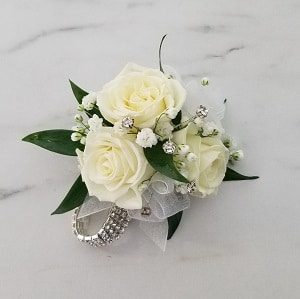
How Much do Corsages Cost?
Updated on | Written by Alec Pow
This article was researched using 8 sources. See our methodology and corrections policy.
A corsage typically costs $30 to $80 when made with fresh flowers by a professional florist. A simple pin-on corsage may cost $25 to $45, while a standard wrist corsage generally costs $40 to $70. Premium designs featuring orchids, garden roses, elaborate ribbon, jewelry-style wristlets, or difficult-to-source flowers can reach $75 to $125+.
Corsages are worn at weddings, proms, homecoming dances, formal celebrations, anniversaries, Mother’s Day events, funerals, and memorial services. At weddings, they are often ordered for mothers, grandmothers, stepmothers, godmothers, officiants, and other honored guests. Prom corsages are usually bought individually or as part of a matching corsage and boutonniere set.
The final cost depends on the event, flower type, number of blooms, wrist or pin-on construction, local labor rates, seasonal availability, and any delivery or customization charges. Wedding orders can cost several hundred dollars because multiple relatives and attendants may receive corsages at the same event.
Article Highlights
Jump to sections
- Most fresh corsages cost $30 to $80 (at $30 per hour, earning that amount would take about 1 to 2.7 hours of work, before taxes).
- Pin-on corsages generally cost $25 to $45.
- Wrist corsages usually cost $40 to $70.
- Premium custom corsages can cost $75 to $125+.
- Wedding corsages for four to eight honored guests can total $160 to $600+.
- Artificial corsages generally cost $15 to $50.

How Much Do Corsages Cost?
The table below provides realistic planning ranges for common corsage types. These are not fixed national prices because florists set rates according to local flower costs, labor, event demand, and the design requested. A corsage taken from a grocery-store floral cooler may cost less than a custom piece designed to match a wedding bouquet or formal dress.
| Corsage type | Typical price | Common use |
|---|---|---|
| Simple pin-on corsage | $25 to $45 (about 0.8 to 1.5 hours of work at $30 per hour) | Weddings, funerals, formal events |
| Standard fresh wrist corsage | $40 to $70 | Prom, homecoming, weddings |
| Premium custom corsage | $75 to $125+ | Luxury weddings and formal events |
| Artificial or preserved corsage | $15 to $50 | Prom, weddings, keepsakes |
| Flower-girl wrist corsage | $20 to $45 | Weddings |
| Corsage and boutonniere set | $45 to $110+ | Prom, homecoming, weddings |
| DIY corsage | $25 to $50 | Any event |
Current florist listings show how wide the market has become. Sage Floral Studio lists a prom wrist corsage at $45, while The Florist at Windward lists a matching 2026 corsage and boutonniere set at $95. National services such as Teleflora, 1-800-Flowers, and FTD also show designs ranging from modest floral accessories to premium delivered arrangements.
Wedding Corsage Costs
Wedding corsages are commonly provided to mothers, stepmothers, grandmothers, godmothers, sisters, aunts, officiants, readers, and other people the couple wants to recognize. Brides describes corsages as floral accessories for important wedding guests and notes that they may be worn on the wrist or pinned to clothing. Modern wedding parties may give them to anyone, regardless of gender, or replace them with boutonnieres, floral bracelets, small bouquets, or pocket flowers.
A simple wedding pin-on corsage generally costs $25 to $45 (about 0.8 to 1.5 hours of work at $30 per hour), while a wrist corsage costs around $40 to $75. Premium orchids, garden roses, keepsake bracelets, metallic details, and flowers coordinated with a custom wedding palette can raise the price above $100 per person.
Quantity makes wedding corsages a more significant budget item than a single prom order. Four standard corsages at $50 each cost $200. Six corsages at $65 each cost $390. Adding four matching boutonnieres at $25 each increases the second order to $490 before delivery, tax, or setup.
Wedding florists may include personal flowers within a larger proposal containing bouquets, ceremony arrangements, and reception flowers. Bundling can simplify coordination, but couples should still request itemized prices so they know how much each corsage contributes to the total floral budget.
Prom and Homecoming Corsages
Prom and homecoming corsages are usually worn on the wrist because formal dresses may be strapless, delicate, or unsuitable for pins. Most current fresh designs cost $35 to $80, with $45 to $65 representing a realistic budget for a standard florist-made piece. Premium designs with orchids, several roses, rhinestones, or decorative cuffs can exceed $90.
A matching corsage and boutonniere set typically costs $45 to $110+. Ordering both pieces from the same florist improves color coordination and may cost less than placing two separate delivered orders. The pieces do not have to be identical. A white spray-rose corsage with navy ribbon can coordinate with a white-rose boutonniere carrying one small navy accent.
Prom season can create concentrated demand, especially when several local schools hold dances on the same weekend. Florists may limit customization, close their order books, or offer only predetermined designs as the date approaches. Ordering approximately two weeks ahead improves availability, though it does not guarantee a discount.
The corsage should be balanced against the rest of the prom budget, including the suit, dress, tickets, dinner, transportation, photographs, and prom dress alterations. Spending $45 to $65 on a comfortable design usually provides better value than choosing the largest arrangement available.
Flowers and Design Choices
Flower choice influences the price, but no flower has one universal corsage rate. The number of blooms, amount of preparation, seasonal availability, ribbon work, and local florist labor can matter as much as the wholesale flower cost. A complicated carnation design can cost more than a simple single-rose corsage if it requires extra construction and embellishment.
Mini carnations, chrysanthemums, daisies, and simple greenery usually support lower-cost designs. Spray roses are common in midrange wedding and prom corsages because several small blooms can be arranged without making the piece excessively heavy. Orchids, calla lilies, ranunculus, garden roses, peonies, and unusual seasonal flowers may increase the price because they can be more expensive, fragile, or difficult to source.
Color requests also affect availability. White, blush, red, pink, peach, lavender, and burgundy are usually easier to produce than an exact match to a difficult dress or wedding shade. So-called black roses or blue roses are often dyed, painted, preserved, or artificial rather than naturally available in the requested color. A florist may recommend neutral flowers with coordinating ribbon instead.
Large corsages are not automatically better. A heavy floral spray may twist around the wrist, catch on lace, or become uncomfortable after several hours. A compact design can look more intentional and may cost less.
Wrist, Pin-On, and Alternative Corsages
Wrist corsages are the most familiar style for prom and are increasingly common at weddings. The flowers are secured to an elastic band, plastic base, ribbon tie, pearl bracelet, metallic cuff, or rhinestone wristlet. A standard wrist base is usually included in the advertised price, while jewelry-style upgrades may add $8 to $30+.
Pin-on corsages are generally smaller and may cost $5 to $20 less than comparable wrist designs. They work well on jackets, sturdy dresses, handbags, and formal coats, but pins can pull or damage chiffon, silk, lace, and thin fabrics. Some wedding guests prefer a pin-on corsage because they dislike wearing flowers around the wrist.
Alternatives include floral rings, small handheld posies, magnetic corsages, flower crowns, pocket-square flowers, corsages attached to handbags, and single stems presented without being worn. These may be chosen for comfort, mobility, sensory preferences, religious attire, or delicate clothing.
Brides’ comparison of corsages and boutonnieres notes that both accessories have become more gender-neutral and are used to identify or honor important guests. Couples and prom attendees should choose the style the wearer will actually enjoy rather than following a rigid tradition.
Fresh, Artificial, and Preserved Corsages
A fresh corsage provides natural texture, fragrance, and variation, but it must be made close to the event and handled carefully. Fresh designs generally cost $30 to $80, although premium wedding pieces can exceed $100. Pickup is usually preferable to long-distance delivery because the flowers spend less time in transit.
Artificial corsages generally cost $15 to $50. They can be ordered weeks or months ahead, inspected before the event, matched closely to an unusual color, and kept afterward. High-quality artificial flowers, handmade details, and keepsake jewelry can push a custom piece beyond $60, so artificial does not always mean inexpensive.
Preserved and dried-flower corsages occupy the middle ground. They provide a natural appearance and longer life but can be fragile. Dried grasses, preserved roses, lavender, and small wildflowers work particularly well for rustic weddings, autumn events, and bohemian formalwear. Online studios such as LOT 450 market dried designs for prom and weddings, showing that corsages are not limited to fresh dance flowers.

Artificial or preserved flowers can also help people with pollen sensitivities, though fragrance, adhesives, and decorative materials should still be considered. The choice should reflect comfort, timing, budget, and whether the wearer wants a keepsake.
Delivery, Service Fees
The displayed product price may not be the final corsage cost. Delivery, service charges, sales tax, premium wristlets, special flower requests, timed delivery, rural delivery, rush production, and matching accessories can increase the checkout amount. Online flower platforms may not show the complete total until the delivery address and date are entered.
Consider a corsage advertised at $49.99. A pearl wristlet upgrade adds $12, delivery and service charges add $20, and tax adds approximately $6.50. The completed order costs:
$49.99 + $12 + $20 + $6.50 = $88.49.
Local pickup with the included wristlet would reduce the same purchase to approximately $54 after tax, a saving of about $34.49. This is why online ordering is not automatically less expensive than buying directly from a florist.
Wedding orders may also include consultation, delivery, setup, and breakdown charges as part of a broader floral contract. A florist delivering bouquets, centerpieces, corsages, and boutonnieres to several locations has a different workload from a shop handing one boxed prom corsage across the counter.
A restaurant-style gratuity of 15% to 20% should not be treated as a mandatory corsage expense. Design labor is generally included in the quoted price. A voluntary tip may be offered for exceptional delivery or last-minute assistance, but practices vary.
Ordering and Caring for a Corsage
Order a custom prom or homecoming corsage about one to three weeks before the event, with two weeks serving as a practical target. Wedding corsages should be finalized with the broader floral order, commonly several months before the wedding, while the florist purchases and assembles the flowers closer to the date.
Early ordering improves access to requested flowers, colors, wristlets, and production time. It does not necessarily lower the price. A florist may accept a simple order several days before an event, but the customer may have to choose from flowers already in stock. During busy prom, Mother’s Day, graduation, and wedding weekends, some shops stop accepting orders entirely.
Fresh corsages should generally be collected on the event day or the day before, following the florist’s instructions. Keep the design in its supplied box, away from direct sun, heaters, and hot vehicles. If refrigeration is recommended, use a cool area that will not freeze the flowers and keep the box away from fruit. Ripening fruit releases ethylene, which can shorten the decorative life of sensitive flowers.
Do not automatically mist the corsage. Water can spot petals, loosen adhesive, damage ribbon, or affect dyed flowers. Avoid placing heavy objects on the box, and put the corsage on shortly before photographs or departure.
DIY Corsage Costs
A DIY corsage commonly costs $25 to $50 when the maker must purchase flowers and every supply. An illustrative project may require $15 in flowers and greenery, a $7 wrist base, $8 in floral tape and wire, and $8 in ribbon and adhesive. The total is:
$15 + $7 + $8 + $8 = $38.
That is close to the cost of an inexpensive florist-made corsage. DIY becomes more economical when supplies are already available or several pieces are being created. Six corsages using $90 in flowers and $45 in shared supplies cost $135, or $22.50 each, before mistakes and labor.
A highly discussed 2026 DIY prom example on Reddit reported spending about $30 on grocery-store roses and baby’s breath after local florist quotes were much higher. Such reports demonstrate possible savings, but they do not prove that every beginner will achieve professional durability or appearance.
Practice is important because fresh stems can snap, adhesive may remain visible, and heavy flowers can pull away from the base. DIY is safest with sturdy flowers, a simple arrangement, or an artificial design prepared several days in advance.
Three Complete Corsage Budgets
Single prom corsage: A standard fresh wrist corsage costs $50, tax adds $4, and the buyer collects it locally. The final cost is $54. Adding a matching $25 boutonniere brings the pair to $79 before tax on the second item.
Wedding family flowers: The couple orders corsages for two mothers and two grandmothers at $55 each, plus four boutonnieres at $25 each. The corsages cost 4 × $55 = $220, and the boutonnieres cost 4 × $25 = $100. The personal-flower subtotal is $320 before delivery and tax.
Premium wedding order: Six custom orchid wrist corsages cost $90 each, creating a subtotal of $540. Delivery and coordination add $75, and tax adds approximately $45. The final cost reaches about $660.
The wedding examples show why a general corsage article cannot focus only on prom. One corsage is a modest accessory purchase, while a wedding order involving several parents, grandparents, attendants, and officiants can become a meaningful part of the floral budget.
How to Save
The most effective saving step is to give the florist a firm budget and ask which designs fit it. Requesting fewer blooms, common seasonal flowers, a standard wristlet, and flexible colors is more constructive than asking for a discount on a labor-intensive custom arrangement.
Wedding couples can limit corsages to the people they most want to honor rather than automatically ordering one for every relative. A pin-on design may save $5 to $20 per person, while one premium flower with greenery can look more polished than a crowded arrangement of cheaper blooms.
Prom buyers can save by ordering a simple corsage and matching the outfit with ribbon rather than paying for dyed flowers, rhinestones, charms, and a jewelry cuff. Local pickup avoids delivery and service charges. Artificial corsages can also be purchased earlier, compared across sellers, and reused.
For weddings, ask whether personal flowers can be bundled with bouquets and ceremony arrangements, but compare the itemized total. Some florists have event minimums that make a small wedding-only corsage order expensive, while a retail flower shop may accept the same order without full-service wedding fees.
The corsage should be judged by comfort, freshness, coordination, and craftsmanship rather than sheer size. A well-made $45 design can provide better value than an uncomfortable $100 arrangement overloaded with decorations.
What We Verified
We checked current prom and formal-event prices from Sage Floral Studio, The Florist at Windward, Teleflora, 1-800-Flowers, FTD, and dried-flower seller LOT 450. We reviewed wedding usage and etiquette through Brides, including who may receive corsages and the difference between wrist, pin-on, and boutonniere styles.
We also compared the current market with active florist pricing, national flower networks, current DIY reports, and retailer supply costs. The former claim that corsages are primarily prom accessories was removed, along with unsupported statements that online ordering is always cheaper, that every florist expects a 15% to 20% tip, and that all fresh corsages should automatically be misted or stored in an unopened refrigerator box.
Answers to Common Questions
How much does a corsage usually cost?
Most fresh corsages cost $30 to $80. Pin-on styles commonly cost $25 to $45, while standard wrist corsages cost approximately $40 to $70.
Who wears corsages at weddings?
Corsages are commonly given to mothers, stepmothers, grandmothers, godmothers, officiants, readers, and other honored guests. Couples can choose recipients according to their relationships rather than rigid etiquette.
How much do wedding corsages cost?
A typical wedding corsage costs $30 to $75. Premium custom designs with orchids, garden roses, or jewelry wristlets may cost $75 to $125+ each.
How much does a prom corsage cost?
A fresh prom corsage generally costs $35 to $80. Most standard florist-made wrist designs fall between $45 and $65.
Are wrist corsages more expensive than pin-on corsages?
Usually. Wrist designs require a base or bracelet and often contain more flowers and decorative work. The difference is commonly $5 to $20.
When should a corsage be ordered?
Prom and homecoming corsages should generally be ordered one to three weeks ahead. Wedding corsages should be included when the couple finalizes the wider floral order.
Can corsages be artificial?
Yes. Artificial and preserved corsages are suitable for weddings, proms, homecoming, and other formal events. They generally cost $15 to $50 but can cost more when handmade with premium materials.
Disclosure: Educational content, not financial advice. Prices reflect public information as of the dates cited and can change. Confirm current rates, fees, taxes, and terms with official sources before purchasing. See our methodology and corrections policy.